
Water that leaves white crust on a faucet and a film on a clean glass is a common complaint in East Orange. The city describes its water as very hard, and the minerals behind that label settle out wherever water is heated, evaporated or pushed through small openings. We install, repair and service water softeners and whole-house filters, and we start with the water you actually have, not with a box off a shelf.
Treatment is a planned project, not an emergency, so a visit is usually scheduled. Call (973) 488-5410 and tell us what you see, what equipment is already in the basement and whether you own the building or rent a unit in it. We will explain the options and give you a price before work starts.
Signs Your Water Is Hard
The most visible sign is scale, a chalky white or tan crust around faucet aerators, showerheads and the base of fixtures. Glass shower doors cloud over and dishes dry with spots even after a full wash cycle. Soap and shampoo lather poorly, and towels can feel stiff.
The less visible signs cost more. Scale forms inside a tank water heater and insulates the water from the burner or element, which makes the unit work harder. It also coats the heat exchanger in a tankless unit, which is why tankless owners hear about descaling. If you already own one, our tankless water heater page explains flushing, and our water heater repair page covers what scale does to a tank.
Scale also narrows pipes, clogs aerators and shortens the life of washing machine valves and dishwasher parts. None of this proves a particular number on a test. It tells you that treatment is worth pricing.
Start With A Test, Not A Guess
East Orange water comes from the East Orange Water Commission, which draws from wells in the Passaic aquifer and disinfects with chlorine. It is not Newark water. Published figures for hardness do not agree with each other, so we do not quote one, and you should be wary of anyone who does without testing your tap.
A home test kit gives a rough reading. The Water Commission's current water quality report gives the system level, and a lab can test your own tap if you want a precise figure. We size a softener from a test, not a guess, because the hardness and the number of people in the building decide how large the unit must be and how often it regenerates.
The same goes for taste, odor or cloudiness. A chlorine smell points to one kind of filter, sediment points to another, and a specific contaminant concern needs a filter certified for that contaminant. We do not claim a filter removes any particular substance unless it carries the matching certification.
Softener Types Compared
The word softener covers several different machines, and they do different jobs. The table below is the honest version of how they compare. We install the first two and the filter systems, and we tell you plainly when a simpler choice fits better.
| Type | What it does | Needs | Trade-offs |
|---|---|---|---|
| Salt-based ion exchange softener. | Swaps hardness minerals for sodium or potassium so scale does not form. | Drain connection, power for the valve head, salt refills. | Most complete answer to scale. Uses salt and water to regenerate and adds sodium to the water. |
| Salt-free conditioner | Changes how minerals behave so they cling to pipes less. | Usually no drain and no power. | Reduces scale buildup but does not remove the minerals. Water still tests hard. |
| Whole-house sediment or carbon filter. | Catches particles and can reduce chlorine taste and odor. | Cartridge changes on a schedule. | Does not soften water. A filter alone will not stop scale. |
| Point-of-use filter | Treats water at one tap, such as a kitchen sink or ice maker. | A small footprint and cartridge changes. | Treats one tap only. Useful for drinking water, no help for scale elsewhere. |
Many homes end up with two stages: a filter first to protect the equipment, then a softener. We lay that out on site so you only buy what the water and the building call for.
Whole-House Or Point-Of-Use Filtration
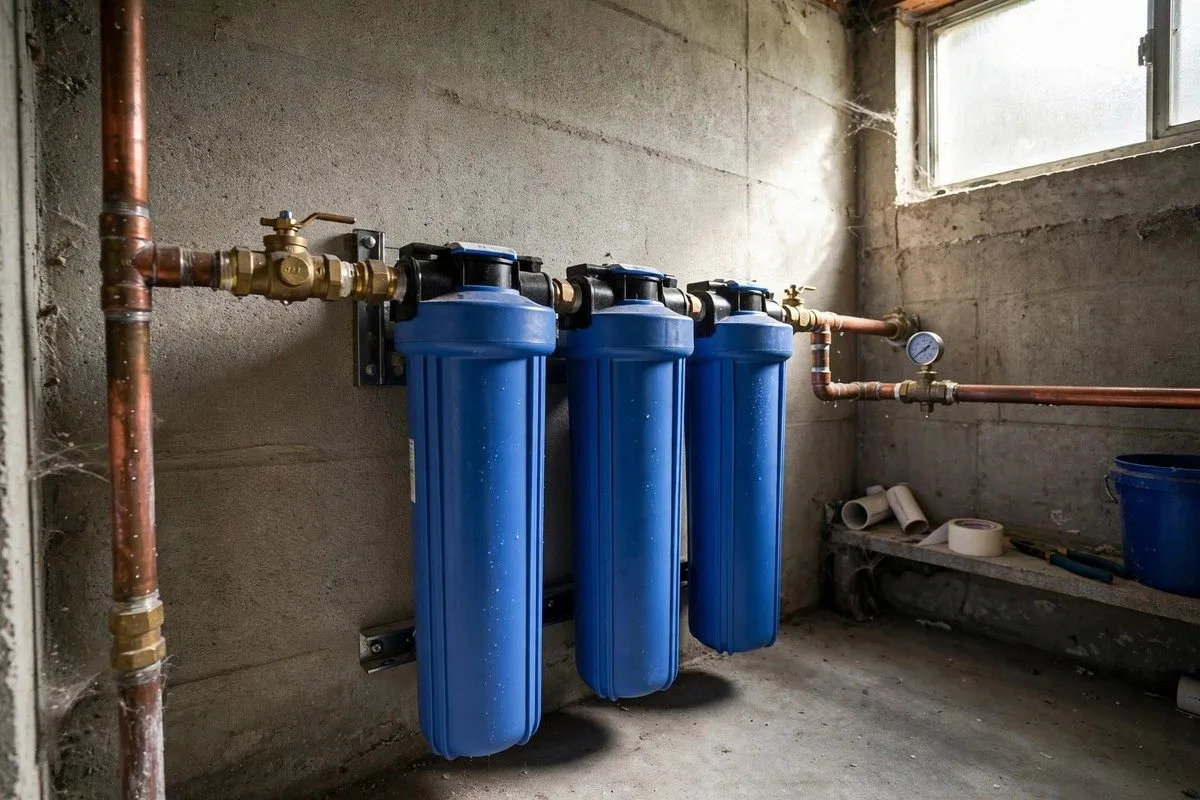
A whole-house system treats every line in the building, so showers, laundry and the water heater get the same water as the kitchen. It sits at the main, usually in the basement, and uses large cartridge housings mounted on a basement wall. That makes sense when sediment or chlorine taste is a household-wide issue.
A point-of-use filter is smaller and cheaper to run, and it fits a rental unit where the main is not yours to alter. If your goal is a certain kind of drinking water, look for the certification that names the specific contaminant you care about. NSF/ANSI standards exist for different contaminants, and a filter certified for one is not certified for another.
We are plumbers, not a testing lab, so we do not diagnose water quality from the sink. We install what you choose and we explain what each product claims on its own label.
Bypass Valves, Drains And Discharge
Every softener install should include a three-valve bypass loop. It lets you isolate the unit for service while the building keeps running on plain water. Without it, a cartridge change or a valve head repair means shutting off water to everyone.
A salt-based softener also needs a place to send its regeneration water. That means a standpipe, a floor drain or a laundry tub with an air gap, so waste water can never flow back into the unit. If the basement has no suitable drain, we plan a route or recommend a small drain pump. Discharge to a sump pit is something we check before we agree to it, since it affects how the sump pump runs.
The overflow line is the part people forget. A stuck valve or a clogged drain can send brine tank water across a basement floor, so the overflow must have its own clear path.
Installing Next To A Water Heater
Softeners and water heaters often share the same basement corner, and the order of the pipes matters. Treated water should reach the heater, and the hot side of the loop should not pass back through the softener. We keep the bypass, the shutoff valves and the heater connections within reach so each can be serviced without moving the other.
If you are replacing an old tank at the same time, it is a good moment to add treatment. Our water heater installation team can plan both together, which avoids cutting the same pipes twice. Plan for clearance, too. A softener, a brine tank and a heater each need room to open and work on.
Metal pipe joints between unlike metals need dielectric fittings or the correct unions. Old galvanized or mixed supply lines are common in East Orange basements, and we check their condition before we tie new equipment into them. Where a line is too far gone, the honest answer is a repair of the line first, which our plumbing installation work covers.
Permits And Who Can Do The Work
In New Jersey, plumbing work must be done by a licensed master plumber, and any permit is signed by that licensee. We are licensed and insured, and we do not hand the job to an unlicensed helper. Whether your specific installation needs a permit depends on what is being connected and changed.
We do not guess at that from memory. If you want to confirm before work begins, call the East Orange Building Division at 973-266-5320. We will tell you what we plan to do so you can describe it accurately to them.
Landlords, Tenants And Multifamily Buildings
East Orange is mostly a city of renters. The city's own housing plan counts about 69 percent of occupied homes as renter occupied, and 38 percent of units sit in buildings with 20 or more apartments. That shapes how water treatment is bought and who can approve it.
A tenant usually cannot cut into the main, so a point-of-use filter or a showerhead cartridge is the realistic option, and only with the landlord's permission. A building owner has more choices. One softener on the building main treats every unit, protects a shared boiler or central water heater and reduces scale in the common lines. Our commercial plumbing team sizes multi-unit systems, and we write up the equipment and settings so a property manager can keep service records.
Owners should also think about access. A softener in a locked basement is a softener that never gets salt. Decide who refills it before anyone buys it.
What Needs Maintenance, And How Often
A salt softener needs salt in its brine tank. Check the level every month or two, and keep it above the water line. If salt forms a hard crust or bridge, the unit can run without actually making brine, and the water goes hard again without any alarm.
Cartridge filters need replacing on a schedule set by the product and by how much sediment your water carries. A filter left too long loses flow and can stop helping. Housings should be opened with the water isolated, and the O-ring checked and lightly lubricated before it goes back.
The control valve regenerates on a timer or by water use. It is worth checking the clock after a power outage, since many heads reset. Resin beds last a long time but are not permanent, and a unit that suddenly stops softening may need a valve, a resin or a cleaning. We repair and service units we did not install, including stuck valves, leaking brine tanks and overflow problems.
Common Problems We Are Called To Fix
- Water is hard again after the unit worked for years, often a salt bridge, a failed valve head or exhausted resin.
- Brine tank overflows or the drain line is spitting water.
- A filter housing drips at the seal, or the pressure gauge shows a drop after a cartridge change.
- Water pressure falls after a new filter goes in because the cartridge is too fine for the flow.
- A valve or bypass is stuck, leaking or was never installed.
If your pressure problem is broader than one filter, we trace it from the meter through the building. Let us know what changed and when it started.
What Water Treatment Costs: The Pricing Factors
We give a clear price before work starts. We do not quote by phone for a system we have not looked at. These five things move the number.
Water Softener And Filtration Near East Orange
We install and service water treatment across the neighboring towns as well, including Orange, Newark, Bloomfield, West Orange and Irvington. Water source and hardness can differ from one town to the next, so we test at each address and do not assume the neighbor's results apply to you.
To plan a visit, call (973) 488-5410. Tell us the building type, what you have installed now and what you want the water to do. We will explain the right size and the work involved before anything is cut.
Code And Standards Reference
Softener and filter installations tie into supply and drain piping, so they follow the plumbing subcode (N.J.A.C. 5:23-3.15), which the state lists as the National Standard Plumbing Code, 2024 New Jersey edition. A filter claim is only as good as its certification, so look for NSF/ANSI certification for the specific contaminant.