
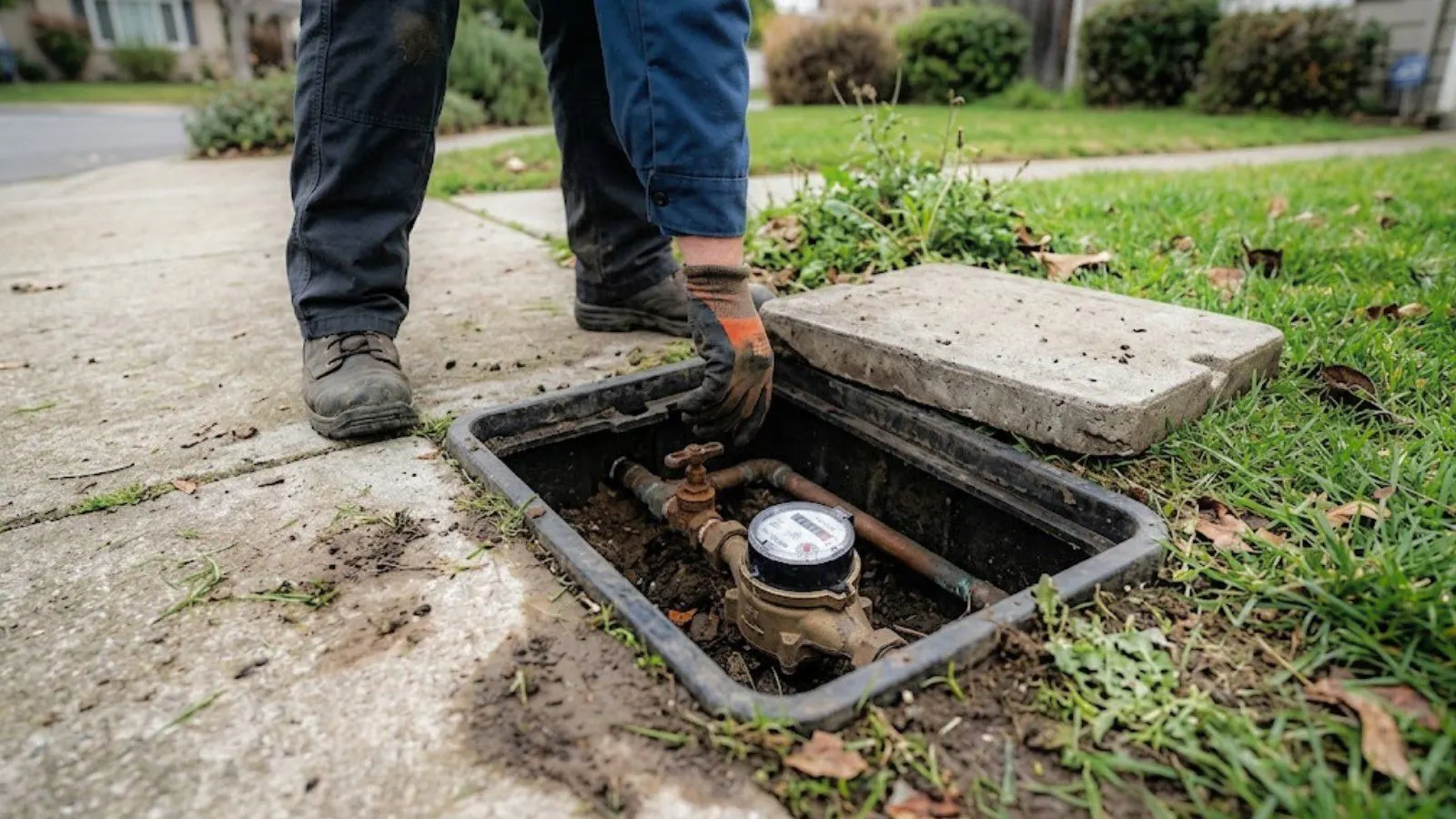
The water service line is the one pipe every building depends on. It runs from the main under the street to your building, and everything inside depends on it. When it leaks, breaks or fails, you can lose pressure, lose water or find a wet patch in a yard with no obvious source.
In East Orange, the line is a shared responsibility. The East Orange Water Commission owns the line from the street to the curb box, and the owner is responsible from the curb box to the building, according to the city's own water FAQ. We repair and replace the owner's side, and we tell you plainly when a problem is on the commission's side instead.
If water is coming up in a yard, a basement wall is wet where the line enters or you have lost pressure, call (973) 488-5410. Close the main valve inside the building first if water is entering the structure.
Water Line Failing Right Now? Do This First
Close the main valve
Shut off the valve where the line enters the building. If it will not turn, do not force it with a long pipe. Call us.
Look at the meter and curb box
Check whether the meter is still spinning with the main closed. If it is, water is leaving the system before the valve. Note it and tell the commission and us.
Keep people away from the wet area
Soft ground over a failing line can collapse. Keep children and pets away from sinkholes and standing water.
Do not dig
Digging without calling 811 first can hit gas and electric lines. We handle the call and the timing.
Where The Service Line Starts And Ends
The line begins at a connection to the water main in the street. A shutoff known as a curb stop sits in a box near the curb, and the line continues to the building, usually through the foundation or below a basement slab, to the meter and the main valve inside.
The commission's responsibility, per its water FAQ, runs from the main to the curb box. Past that point is the owner's. The commission's own program documents describe the owner's responsibility as running from the home to the curb stop. That is why we always find the curb box first and ask what you have seen before we dig.
| Part of the line | Who is responsible | Who to call |
|---|---|---|
| Main in the street to the curb box. | East Orange Water Commission. | Commission at 973-266-8869 |
| Curb box to the building. | The property owner | A licensed plumber, such as us. |
| Meter and piping inside the building. | The property owner, with commission rules for the meter. | Call the commission about the meter and a plumber for the piping. |
Signs Of A Failing Water Line
The signs are easy to miss. A meter that runs with every fixture off, a patch of lawn or sidewalk that stays wet, a sudden drop in pressure and unexplained moisture where the line enters the foundation all point to the line. Sometimes the first sign is a bill that is higher than normal.
Brown or cloudy water after pressure has dropped can also come from a line problem, but it can come from other causes, such as work on the street main. We check the line and the pressure at the building before telling you which is likely. Our leak detection service covers locating the exact spot with listening equipment and pressure tests.
Lead Service Lines And The City Program
Many older service lines were made of lead, and New Jersey law requires them to be replaced. According to the state's Department of Environmental Protection, lead service lines must be removed within 10 years, by July 2031. East Orange has about 10,000 lines in its program, and a state loan announcement in 2026 describes the current phase as about 1,790 lines, one of four remaining phases.
The 2026 water quality report says a service line inventory is available at www.eowater.com. Call the Water Commission at 973-266-8869 to ask whether your address is on the list, what material the line is and when your phase is scheduled. We cannot say replacement is free for every owner, and we will not tell you it is. Ask the commission what, if anything, it covers for your property and what falls to you.
If your line is leaking and may be lead, do not rush to patch it. Call the commission first, because replacing the owner's side at the same time as the commission's can avoid digging twice.
Repair Or Replace: How We Decide
A leak on the owner's side of the line is sometimes a simple repair. If the pipe is sound and the break is a single point, such as a failed joint or a damaged section, we can cut it out and connect new pipe. The repair is faster and disturbs less ground.
Replacement makes more sense when the line is lead or galvanized, when it has leaked more than once or when the pipe wall is clearly thinning. Digging up a line to patch it and then digging it up again next year costs more than doing it once. We show you what we find in the trench and explain the tradeoff before we commit.
Low pressure alone does not always mean the line is bad. A partly closed valve, a failing pressure regulator or scale inside old pipes can cause the same symptom, so we test each before recommending a new line.
Call 811 Before Any Digging
New Jersey law requires excavators to notify NJ One Call, at 811 or 1-800-272-1000, not less than three and not more than ten business days before digging. The notice stays valid for 45 business days, and homeowners are covered by the rule too. That window means a planned water line job cannot start the same day, though a failing line sometimes needs an emergency response.
Utilities mark gas, electric, telecom and other lines for free, and we coordinate the schedule so the crew arrives after the marks are in place. In an emergency, we close the valve and protect the property first, and dig only after the marks are done unless safety demands otherwise.
Trenchless Or Open Trench: How Water Lines Get Replaced
Open trench means digging a trench along the line, removing the old pipe and laying new pipe. It is direct and lets us see the whole line. It means a trench through a yard, driveway or sidewalk and restoration afterward.
Trenchless methods replace the pipe with much less digging, working from small pits at each end of the line. They are not right for every line. A collapsed section, a sharp bend or a very short run may call for open trench, so we look at the line before recommending a method. In a tight East Orange lot, trenchless can mean much less disturbance to a driveway or a neighbor's fence.
Restoring The Site After The Work
Replacing a water line leaves a trench or a pair of pits, and we plan for what goes back on top. Sod, gravel, concrete and asphalt are different jobs, and a sidewalk or a public right-of-way may involve the city or the commission. We tell you at the start what restoration is in our scope and what falls to another party.
Before we close the ground, we pressure test the new line, check that the meter and curb box connect properly and flush the line so debris does not reach your fixtures. Then we restore water and check pressure at the highest and lowest fixtures in the building.
Permits And Approvals
New water service work involves the Water Commission and the city. The commission handles connections to its main, and replacing water supply piping is not ordinary maintenance under N.J.A.C. 5:23-2.7. We cannot give you a permit answer from memory, so confirm with the Water Commission at 973-266-8869 and the Building Division at 973-266-5320 before a job is scheduled.
Plumbing work must be done by a licensed master plumber under New Jersey law, and the permit is signed by the licensee. We handle the paperwork once the commission and Building Division tell us what your address requires.
What Water Line Work Costs: The Pricing Factors
Water Line Repair Near East Orange
We handle water lines across the area in Orange, Newark, Bloomfield, West Orange and Irvington. If a pipe inside the building has already burst, our burst pipe repair team can respond now.