
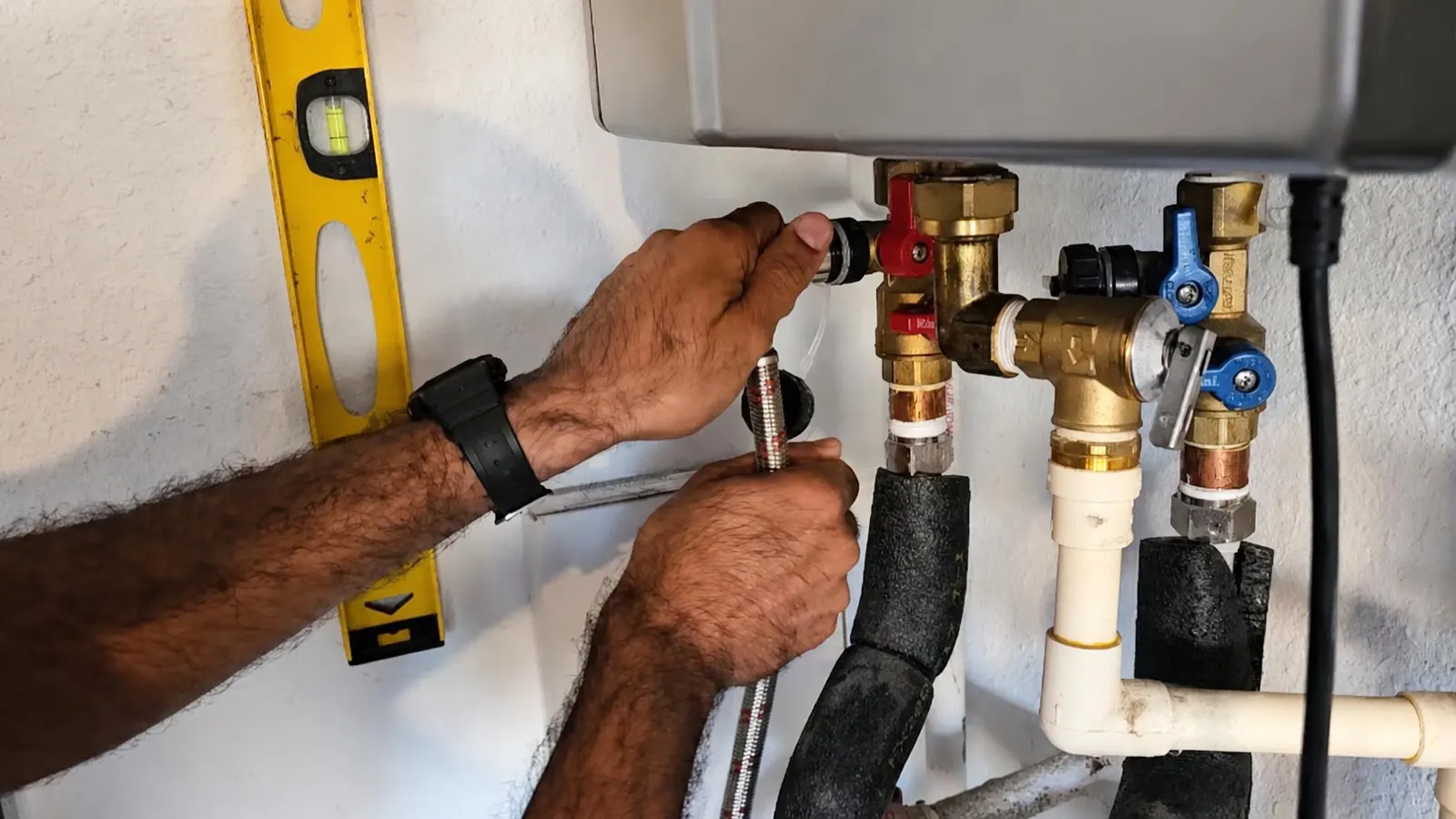
A tankless water heater heats water as it flows instead of storing it. That means no standby tank to leak or to run out, and a unit that can last longer when it is maintained. It also means a bigger gas line, a different vent and a maintenance routine that cannot be skipped. In East Orange, where the city itself calls the water very hard, that routine is the whole story.
We install tankless water heaters, convert tank systems and service existing units. Many owners are not shopping for a new unit at all. They need to flush and descaling a unit that has started to throw error codes or lose output.
Tankless Installation: What The Job Involves
A tankless install is a different job from a tank swap. The unit mounts on a wall, uses a specific vent type, and needs a gas line and water supply that can deliver the flow it demands. Gas models draw much more gas at full fire than a tank burner does, so the existing line is checked before anything else.
We also install service valves with the unit so it can be flushed later. That small detail matters in East Orange, because it makes descaling a routine task and not a major repair. Electric tankless units skip the venting but need a heavy electrical circuit that many older buildings cannot supply without work.
Converting From A Tank To Tankless
Conversion adds scope compared with a plain replacement. The old tank, its flue and often its piping have to be removed or reworked, and the new unit needs a vent path and a supply line sized for it. In older multifamily buildings with a shared flue, that work can reach beyond one apartment.
We do a site visit first and give you a written scope. If the venting or gas line makes tankless impractical, we say so and discuss a tank instead. See water heater installation for how planned installs work and water heater replacement for emergency swaps.
Flushing And Descaling: Why It Matters Here
Tankless heat exchangers have narrow passages. Minerals from very hard water form scale inside them, which restricts flow, reduces heat transfer and eventually triggers error codes or cold spots. The city's softening page notes scale buildup in water heaters in general, and a tankless unit has less tolerance for it than a big tank does.
A flush circulates a descaling solution through the heat exchanger and then rinses it. It is a few hours of work on a unit with service valves. Without those valves, a flush is harder, which is one reason to include them at installation.
- Error codes related to ignition, flow or temperature.
- Hot water that fades or turns lukewarm during a shower.
- Longer waits for hot water at the tap.
- Rumbling or popping from the unit.
- A unit that has not been flushed in a year or more.
Any of these is a reason to call. We check the unit, flush it if scale is the cause and tell you if something else is failing, such as a sensor, fan or igniter.
Tankless Versus Tank At A Glance
The right choice depends on the building, not on a general rule. This comparison shows where each type tends to win in East Orange homes and multifamily properties.
| Factor | Tankless | Storage tank |
|---|---|---|
| Hot water supply | Continuous, limited by flow rate at the unit. | Limited by tank size, then recovery time. |
| Space | Wall mounted, small footprint. | Floor space and clearance needed. |
| Install complexity | Gas line, vent and sometimes electrical upgrades. | Usually reuses existing connections. |
| Maintenance | Regular flushing, especially in hard water. | Flushing and anode rod checks. |
| Failure mode | Scale, sensors, ignition and fan faults. | Tank corrosion and leaks. |
Sizing And Flow Rate
A tankless unit is rated by how many gallons per minute it can heat by a given temperature rise. Cold incoming water in a north New Jersey winter makes that rise larger, so a unit that looks adequate on paper may fall short in January. We size for your fixtures and your coldest water, not for an average day.
In a small apartment, one unit may serve one bathroom and a kitchen easily. In a two-family house with several showers running at once, a single unit may fall short, and two units or a tank may fit better. We ask how many people use hot water at the same time and plan from that answer.
Error Codes And Common Tankless Faults
Tankless heaters display codes for ignition, flow, venting and temperature faults. Many of these are linked to scale in the heat exchanger or a clogged inlet filter, which is why flushing is the first step. Others point to a failed sensor, a weak fan or a gas supply that cannot keep up.
Do not keep resetting a unit that throws the same code. Write the code down and call us. We read it against the manufacturer's list, check the gas and water supply and tell you whether the cure is a flush, a part or a larger decision. Keep the owner's manual nearby, since it lists the codes for your exact model.
Water Softeners And Tankless Units
Some owners respond to very hard water by installing a softener. The city's softening page makes two points relevant here: scale builds up in water heaters, and softened water can raise lead and copper leaching from brass fixtures after water stands overnight. Both are reasons to talk to us before choosing a treatment system.
A softener can reduce scale in a tankless unit, but it adds its own maintenance and plumbing work. We explain how it would connect to your piping and whether a regular flush schedule would do the job without it.
Gas Line, Venting And Electrical Needs
A gas tankless heater needs enough gas volume and pressure to fire at its rated input. Many older buildings have a gas line sized for a small tank burner. We check the pipe size, the length of run and the meter capacity, and we tell you if the line needs upgrading.
Venting is the other limit. Tankless units use sealed or special vent materials and need clearances to windows and air intakes. Where PSE&G gas is involved, if you ever smell gas, leave, go 350 feet away and call 1-800-880-7734 or 911.
Rebates: What Is And Is Not Available
The federal 25C tax credit ended for property placed in service after December 31, 2025, so it does not apply to a tankless installed now. PSE&G lists a tankless appliance rebate on its pages, but the status is unverified and the listed terms have differed between pages. Call PSE&G at 1-855-846-2895 to confirm whether it is open and which models qualify.
We do not quote rebate amounts, because they change and we cannot promise one. Ask PSE&G before you buy, keep your receipts and read the claim deadlines.
If a rebate matters to your decision, make that call first. A rebate that is closed or that excludes your model should not change which unit is right for the building, and it should never be the reason to delay a failed heater repair in winter.
When Tankless Is A Poor Fit
| Situation | Why tankless struggles | Better option |
|---|---|---|
| Gas line too small. | Unit cannot reach full output. | Tank, or a gas line upgrade if the project justifies it. |
| Shared flue or no vent path. | Venting is costly or not possible. | Tank unit with existing flue. |
| Very high simultaneous demand. | One unit may not keep up with several showers. | Larger unit, multiple units or a tank. |
| Building will not allow flushing access. | Scale cannot be managed. | Tank with regular flush and anode check. |
| Short-term plan for the property. | Payback takes years | Standard tank |
What Tankless Work Costs: The Pricing Factors
We price after seeing the space, and we do not quote numbers over the phone for work we have not looked at.
Tankless Service Near East Orange
We service and install tankless units in Orange, Newark, Bloomfield, West Orange and Irvington. Call (973) 488-5410 and tell us the make, the error code and how long since the last flush.