
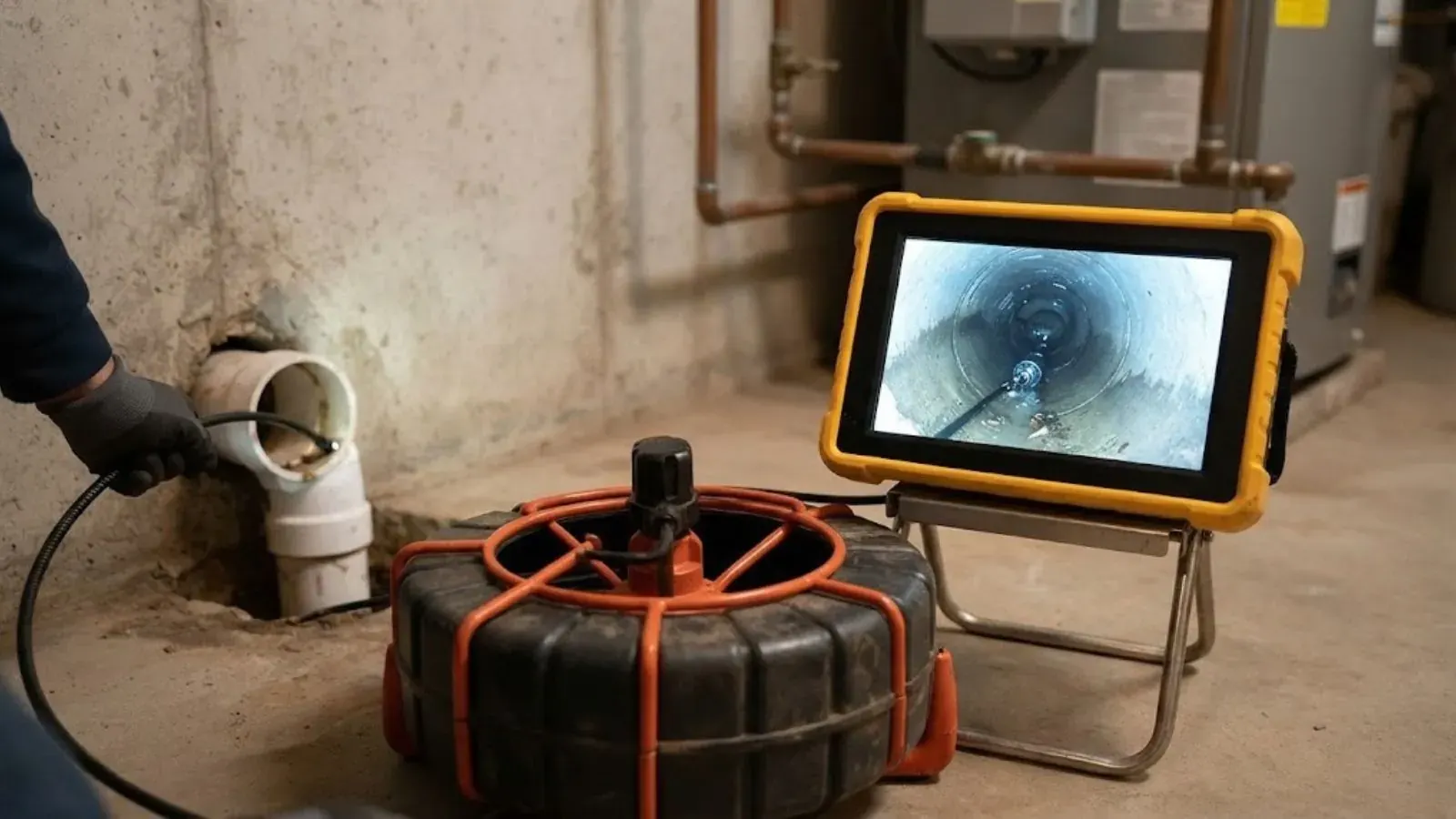
A sewer line is buried, so most people have no idea what condition it is in until it fails. A camera inspection changes that. We feed a waterproof camera through the line and watch the inside of the pipe on a screen, which turns a guess into something you can see.
In East Orange the case for looking is strong. The city's draft housing element puts the median home at 1957, and nearly 30 percent of occupied homes date to 1939 or earlier. Pipes laid in those decades have had a long time to crack, shift and collect roots.
What The Camera Shows You
The camera travels the line from a clean-out, a removed toilet or a roof vent, depending on access. A light on the head shows the pipe wall, and the screen shows what is inside as it moves. The image is clear enough to separate a crack from a joint, and a root mass from grease.
We look for cracked or broken sections, offset joints where two pipes no longer line up, bellies where a sag holds water, root intrusion, scale and buildup, and any place where the pipe changes material or size. We also note the pipe diameter and where branch lines join.
When An Inspection Makes Sense
Not every clog needs a camera. A single slow sink usually does not. These situations do.
Repeat clogs are the main one. If a line has been cleared and clogged again, something is holding the debris, and cleaning alone will not find it. A backup after a cleaning, a sewage smell with no visible cause and gurgling in several fixtures are all reasons to look.
Buying a building is another. A two to four family property can carry a lateral that nobody has seen in decades, and an inspection before closing puts a real condition on the line. Finally, look before a repair or lining. A liner or a spot repair is planned from the footage, so the camera comes first.
Pipe Materials In A 1957-Median Housing Stock
Age tells us what we are likely to find. Older laterals are often clay or cast iron, and mid-century lines may be a different material, such as fiber or pitch-type pipe. Newer repairs are usually PVC. We identify the material on camera and say what it means for the repair options.
Clay tends to fail at joints, where roots find the gaps. Cast iron tends to scale and thin from the inside. Offset and sagging sections show up in any older material. Knowing which one you have shapes whether cleaning, hydro jetting or a sewer line repair is the safe next step.
| Finding on camera | What it usually means | Likely next step |
|---|---|---|
| Roots at joints | Open joint letting roots enter. | Cut roots, then consider lining or a spot repair so they do not return. |
| Heavy scale or grease. | Buildup narrowing the pipe. | Cleaning or jetting if the pipe wall is sound. |
| Offset joint or belly. | Soil movement or settling. | Spot repair, since cleaning only treats the symptom. |
| Crack or collapse | Structural failure | Repair or replacement. Jetting is not safe on this pipe. |
| Clear, smooth pipe | Problem may be in the house line or a fixture. | Look at the building drains and venting. |
Locating The Problem Above Ground
A camera tells you what is wrong. A locator tells you where. The camera head carries a transmitter, and a receiver above ground picks up the signal and reads the depth. We mark the surface so the spot can be dug, or so you can see how the lateral runs under the lot.
This matters for planning. It shows whether a repair sits under a lawn or a slab, and it tells us whether the pipe crosses a property line. Before any excavation, call NJ One Call at 811, which is the state requirement and applies to homeowners too.
What We Give You: Written Notes Of What We Saw
After the inspection we give you written notes of what we saw. They describe the pipe material where we could tell, the location and type of each problem, the approximate distance from the clean-out and our recommendation. We do not grade or certify the pipe, and we do not guess at things the camera could not reach.
Owners and managers use the notes with a lender, an insurer or a contractor. The owner is responsible for the lateral up to the Water Commission main, according to the commission's program documents, so knowing where a problem sits relative to that point is useful. If the problem is past it, call the Water Department at 973-266-8869.
What A Sewer Camera Inspection Costs: The Pricing Factors
We explain the price before we start. Five factors decide it, and none of them require a dollar guess from us on the phone.
Sewer Inspections Near East Orange
We inspect sewer lines in Orange, Newark and Bloomfield, and across West Orange and Irvington. If the camera finds a clog only, our sewer line cleaning service can clear it in the same visit.