
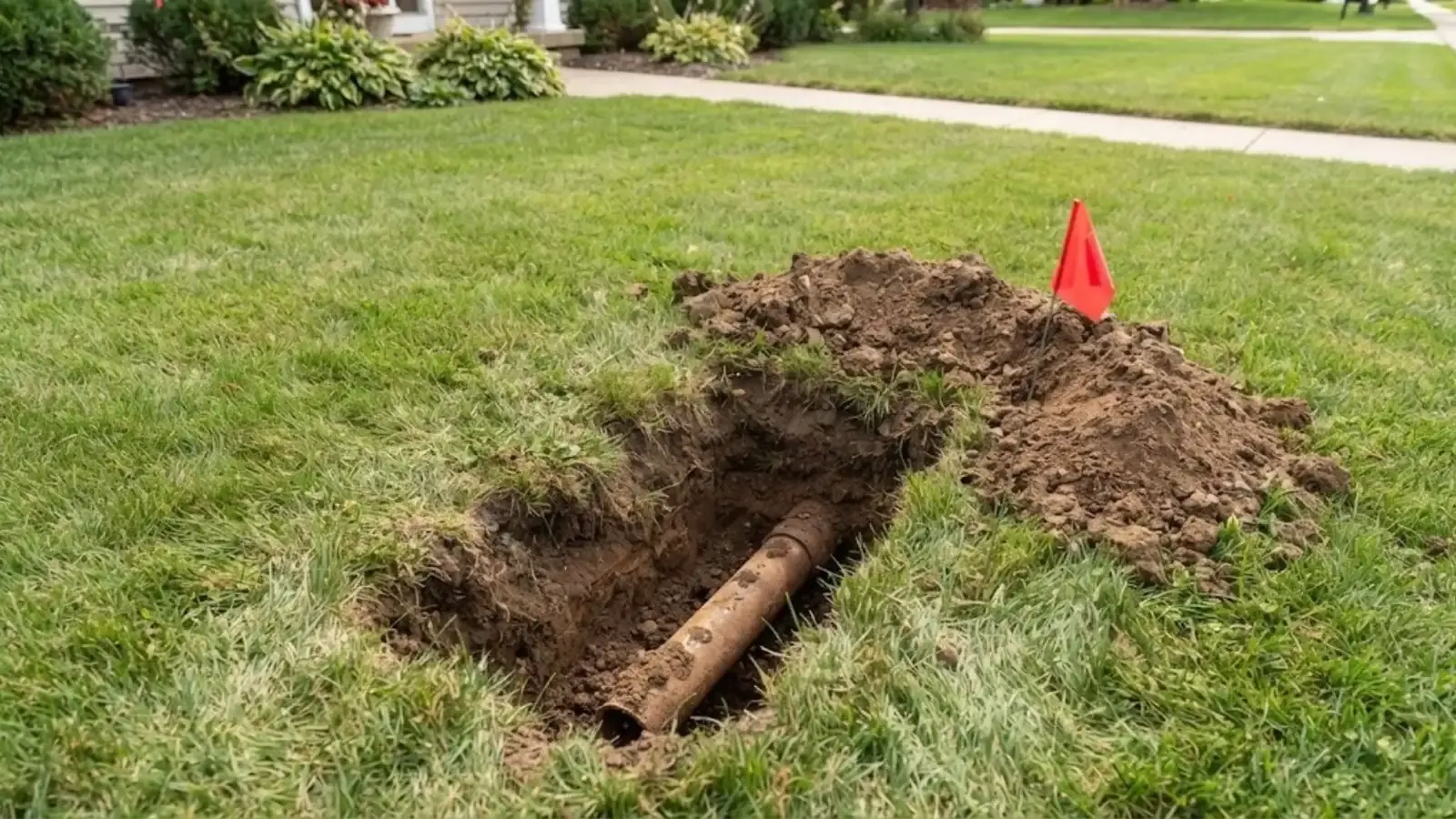
A broken sewer line does not announce itself politely. It shows up as sewage in a basement floor drain, a toilet that will not stop gurgling, or a wet patch in the yard that smells wrong. In East Orange, where most buildings hold several apartments on one lateral, a failed sewer line affects every unit that drains through it.
We repair sewer lines at any hour. The first job is stopping the damage, the second is finding out exactly what failed, and the third is choosing between a spot repair, a full replacement and a pipe lining. We show you the camera footage before we recommend anything, because the right repair depends on what the pipe looks like inside.
Call the 24/7 line and tell us what is happening. If sewage is coming up right now, say so first and we will tell you what to do while the crew is on the way.
Sewage Backing Up? What To Do Right Now
A sewer backup is different from a slow sink. The water is carrying waste, and it will keep rising as long as the building keeps sending water into the line. These four steps limit the damage until a technician arrives.
Stop all water use
No flushing, showers, laundry or dishwasher cycles. Tell every unit on the same line, because one flush upstairs can reach a basement drain within seconds.
Keep people and pets away
Water that came up from a sewer line is contaminated. Keep children and animals out, and wear boots and gloves if you must walk through it.
Protect the basics
Shut off power to a flooded area only if you can reach the panel without standing in water. If you cannot, leave it and tell us when you call.
Skip the chemical openers
Caustic products do nothing for a broken pipe and can burn the crew. Call us instead and describe which fixtures are affected.
How We Find The Break: Camera Diagnosis
We do not dig on a guess. A waterproof camera on a flexible cable goes in through a clean-out, and the picture on the screen shows the pipe wall, the joints and anything sitting in the line. A cracked bell, an offset joint, a belly that holds water, root intrusion and a fully collapsed section all look different on camera.
The camera also gives a distance and, with a locator, a spot above ground. That lets us mark where the problem sits before any digging starts. If you want to understand the footage in more detail, our page on sewer camera inspection explains what the screen shows and what you receive afterward.
Spot Repair, Replacement Or Lining: Choosing The Fix
There are three real options, and each one fits a different pipe. A spot repair cuts out a short failed section and joins new pipe to the sound pipe on both sides. A full replacement removes the old lateral and installs a new one. A lining leaves the old pipe in place and builds a new pipe inside it.
Which one makes sense depends on how much of the line is damaged, how deep it is, what sits above it and what the pipe is made of. A single crack in an otherwise sound line points toward a spot repair. A line with many cracked joints, heavy scale or repeated root problems points toward replacement or lining.
| Option | Best fit | Trade-offs |
|---|---|---|
| Spot repair | One short failed section, accessible by a small excavation. | Lower scope and quicker, but the rest of the old pipe stays as it is. |
| Full replacement | Collapsed, badly offset or widely cracked line, or pipe that has failed more than once. | Most work and most disruption above ground, but the result is new pipe end to end. |
| Pipe lining | Sound alignment with cracks, rough walls or joint leaks over a longer run. | Little digging. The liner reduces the inside diameter slightly and needs a clean, camera-checked pipe first. |
| Cleaning only | A clog with no structural damage. | Cheapest, but it fixes nothing if the pipe is broken. |
Sewer Pipe Lining Explained
Lining, sometimes called cured-in-place pipe, starts with cleaning the old pipe thoroughly, usually with hydro jetting when the pipe is sound enough to take it. A flexible resin-soaked tube is then pulled or inverted into the line and expanded against the old pipe wall. Once the resin hardens, the result is a smooth pipe inside the old one.
It suits a line that is still aligned but leaking, rough or root-invaded at the joints. It does not suit a pipe that has collapsed, sagged badly or separated so far that the tube cannot pass. We tell you plainly which case you have, since a liner pulled through a broken line just fails in a new place.
Why East Orange Sewer Lines Fail
Age does most of the damage. The city's draft housing element reports a median home built in 1957, and 29.8 percent of occupied homes were built in 1939 or earlier. Lateral pipes from those decades are often clay or cast iron, and joints loosen over time, letting roots and soil in.
Heavy rain adds load. The 2018 master plan names basement flooding across the entire city as a Superstorm Sandy effect, and Hurricane Ida in 2021 set a rainfall record in nearby Newark with more than 3 inches in a single hour. A lateral with cracks or open joints takes on groundwater in a storm and can back up when the system downstream is full.
The city's own sewer does not run alone. The Water Commission's minutes record that East Orange discharges its sanitary sewer into a combined sewer carried by Newark. When that downstream system fills in a storm, a backup can come from beyond your property line, which is one reason a camera check matters before anyone blames the building's pipe.
Who Owns The Line: Owner And Commission Responsibility
According to the Water Commission's own program documents, the owner is responsible for the sewer lateral from the building to the point where it connects to the commission's main. The main itself belongs to the commission. If the camera shows the failure past that point, we tell you and you notify the Water Department at 973-266-8869.
Landlords and property managers should keep the footage and our written notes. They show where the failure sits and what was done, which helps with tenants, insurers and any conversation with the commission. For owners of larger buildings, our commercial plumbing team handles the multi-unit side of the work.
What Happens On A Repair Visit
The crew arrives, confirms the symptoms and opens the line at the nearest clean-out. If the line is blocked, we clear it enough for the camera to pass, since the footage cannot be read through standing sewage. You see the screen and we point out the problem as it appears.
Once we know the repair type, we explain the scope, the price and the steps in order. Nothing is dug or cut until you agree. After the work, we run water through the line again and camera it a second time when the repair method allows, so the result is confirmed and not assumed.
Permits, Digging And Utility Marking
Replacing sewer piping is not ordinary maintenance under N.J.A.C. 5:23-2.7, so a permit is needed. Clearing a stoppage does not need one, but replacing sewer pipe does. In New Jersey plumbing work is done by a licensed master plumber, and the permit is signed by the licensee. The Building Division at City Hall can be reached at 973-266-5320 to confirm what applies to your address.
East Orange water and sewer connection applications go through the Water Department at 973-266-8869, according to the city's notes. Before any excavation, New Jersey requires a call to NJ One Call at 811, and homeowners must call too. We place the call as part of the job, but you should know the rule, since markings protect gas, electric and water lines near the trench.
What Sewer Line Repair Costs: The Pricing Factors
We do not quote a number by phone for a line we have not seen. After the camera pass we give you a clear price in writing. These five things move it.
Sewer Line Repair Near East Orange
We repair sewer laterals in Orange, Newark, Bloomfield, West Orange and Irvington, and the same 24/7 number answers for every address. If your problem is a plain clog without damage, sewer line cleaning and drain cleaning are the lighter options, and we will tell you if that is all you need.