
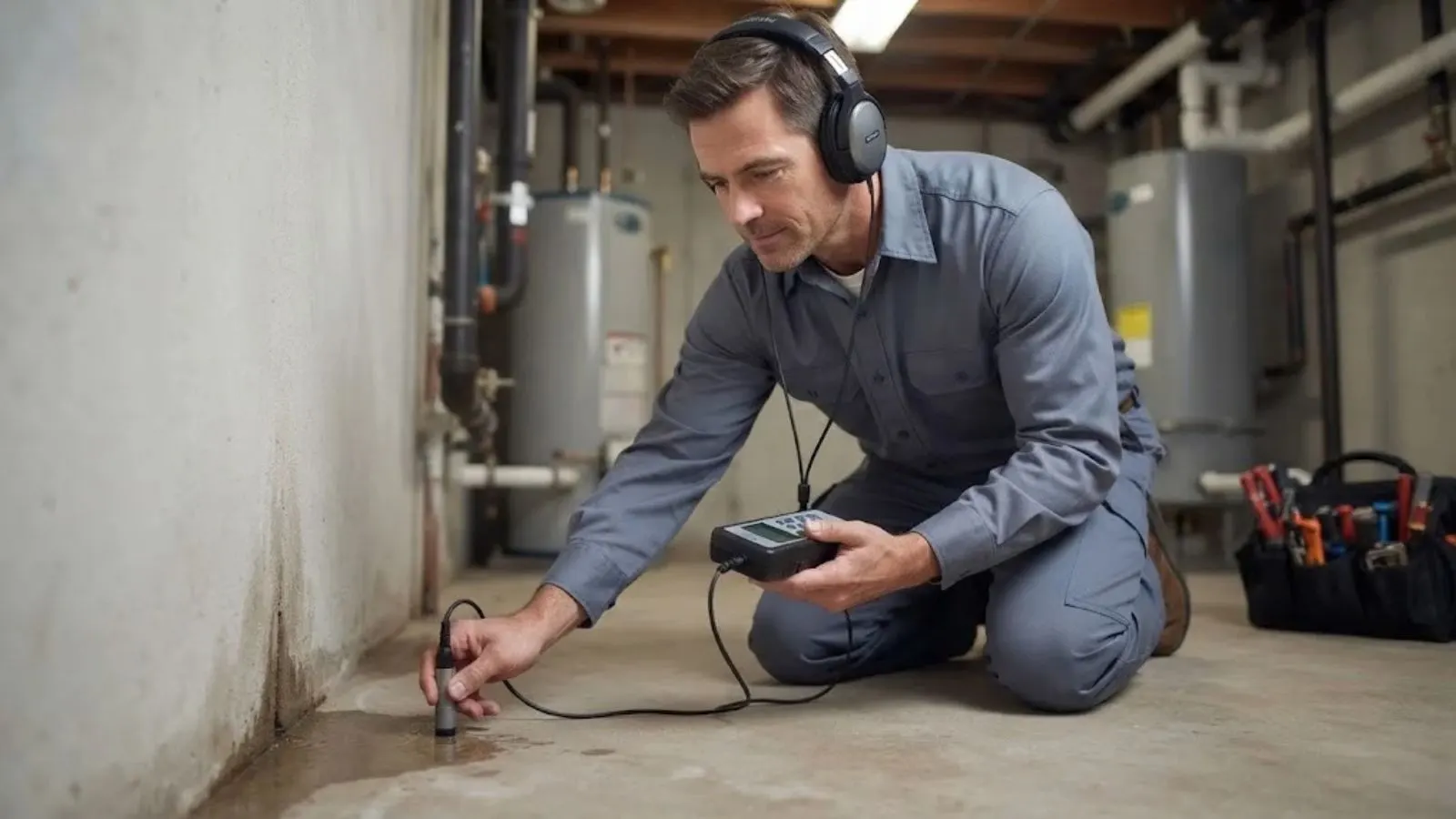
A leak you cannot see is the hardest kind to stop. The water may be inside a wall, under a floor or in a pipe between the street and your building. By the time a stain shows up, the damage has often been spreading for a while.
East Orange housing adds a wrinkle. The city's draft housing plan counts about 69 percent of homes as renter occupied and 38 percent of units in buildings of 20 or more, so one hidden leak often involves several households.
We find leaks before we open anything. A technician listens to the pipes, checks pressure, reads the meter and uses cameras or thermal imaging where they help, and then tells you where the water is going and what it will take to fix it. Call (973) 488-5410 at any hour if water is actively running, and describe what you see.
One honest limit up front. No method locates every leak without opening a surface, and we will not promise that a job can be done without cutting a wall or breaking a slab. What we can promise is that we will narrow the search so any opening is as small as the evidence allows.
Active Leak Right Now? Do This First
A slow drip can wait for a scheduled visit. Water spraying, a ceiling bulging with water, a wet floor near electrical panels or a meter dial that will not stop spinning is different. Those need a shutoff and a call now.
Shut off the water
Close the main valve where the line enters the building. In an apartment, close the unit shutoff if there is one and tell the building manager to close the riser.
Keep power away from water
If water is near outlets, a panel or a ceiling light fixture, turn off that circuit at the panel only if you can reach it while standing on dry floor. Otherwise stay clear and call.
Photograph and note the time
Take pictures of stains, wet spots and the meter. A landlord, manager or insurer will ask for them later.
Call and describe the signs
Tell us where it is wet, whether the meter moves with everything off and whether upstairs or downstairs neighbors are affected.
How We Find A Hidden Leak
We usually start with the simplest test that can rule something in or out. Reading the meter with every fixture off tells us whether water is leaving the system at all. Pressure testing a section of pipe tells us whether the leak is in that section or somewhere else.
Acoustic listening comes next. A sensitive microphone and headphones pick up the sound of pressurized water escaping from a pipe, and moving the sensor along a floor or wall narrows the location. Thermal imaging shows temperature differences, which helps with hot water lines and radiant heat because a leak changes how a surface warms or cools.
A small camera can look inside a drain line or into an opened wall cavity. Where a pressurized line is suspected and other methods are inconclusive, a technician may use tracer gas, a harmless gas that is introduced into an isolated pipe and then detected where it escapes. We explain which method we are using and why.
| Method | What it finds | Honest limits |
|---|---|---|
| Meter and pressure test. | Whether a leak exists and which section of pipe holds it. | Does not pinpoint the spot by itself. |
| Acoustic listening | Pressurized leaks in supply lines, often under floors or in walls. | Traffic, running appliances and plastic pipe can muffle the sound. |
| Thermal imaging | Warm or cold patterns from hot lines, wet insulation and radiant tubing. | A surface scan only, and results need confirming by another method. |
| Camera inspection | Cracks, offsets and leaks inside drain and sewer lines. | Needs an access point and a clear line. |
| Tracer gas | Small leaks in isolated lines when sound methods fail. | Used selectively, and it cannot promise a result. |
Water Meter And High Water Bill Checks
A water bill that jumps without a change in how people live in the building is the most common reason to look for a leak. The first step costs nothing and takes ten minutes. Turn off every faucet, appliance, ice maker and irrigation timer, including the toilets, and make sure nobody flushes.
Then find the meter and look at the small dial or triangle that spins with even the slightest flow. If it moves while everything is off, water is leaving the system somewhere. If it stands still, the leak, if there is one, is likely on a fixture that only leaks while in use, such as a toilet that refills in the night.
A toilet is the usual suspect. Drop a few drops of food coloring in the tank, wait without flushing, and look for color in the bowl. Color means the flapper is letting water through, and that is a quick repair as covered on our toilet repair page.
Where the meter sits matters. In some buildings it is inside near where the line enters, and in others it is in a box near the curb. The curb box is also the point where responsibility changes. The East Orange Water Commission is responsible for the line from the street to the curb box, and the owner is responsible for the line beyond it, according to the city's own water FAQ.
If the dial moves with everything off, the leak could be on either side of that point, or inside the building. We test to tell which.
If it is the commission's side, we give you what you need to report it to the Water Commission at 973-266-8869, and if it is the owner's side we price the repair with you. Do not assume a high bill means the utility made a mistake before the meter test is done.
Slab And Under-Floor Leaks
Slab leaks get a lot of attention online, and many pages talk as if every home sits on a concrete slab. That is not a safe assumption here. East Orange has a mix of older houses, two and three family homes and a large number of apartment buildings, and we could not verify how many have basements, crawlspaces or slabs. Which one you have changes what a leak looks like and how we reach it.
On a slab or a ground floor over concrete, the signs are a warm spot on the floor, a hissing sound at night, unexplained moisture or mold under flooring, and a meter that runs with everything off. We confirm the leak with pressure tests and acoustic listening, then mark the spot on the floor.
A repair then has options. We can break out the slab over the leak, reroute the line through walls or ceilings so the buried section is abandoned, or in some cases line the pipe. The right choice depends on the pipe, the location and how many other sections are in the same condition. We discuss that with you before any concrete is cut.
Service Line Leaks Between The Curb And The Building
The water service line is the pipe that carries water from the main to your building. A leak on it rarely shows as a drip inside. More often you see a wet patch in a yard or sidewalk, a basement wall that stays damp near where the line enters, soft ground, or a bill and meter that tell the story with no visible water.
A leak on the building side of the curb box is the owner's repair. Older lines can be lead, and the commission is running a lead service line replacement program, which we cover on our water line repair page. If we find a leak on a line that may be lead, we stop and discuss it before recommending a patch, because replacing the line may be the better plan.
Ceiling And Wall Leaks In Multifamily Buildings
A stain on a ceiling in an apartment building almost never belongs to the unit where the stain appears. The water may be coming from the apartment above, from a riser in the wall, from a roof or from a drain line in the floor above. Finding the source takes patience and some coordination.
We start by checking moisture on the ceiling and walls, then work upward and sideways to see where the readings rise. If the building manager allows, we run the fixtures upstairs one at a time to see which one reproduces the leak. A tub overflow, a toilet supply line and a washer hose are the usual culprits.
Upstairs neighbors are part of this. A tenant who suspects the unit above should tell the landlord or manager right away and ask for access.
We document what we find with photos and a plain written description so a landlord, property manager or insurer can see the cause. If a heat or hot water line is involved, remember New Jersey sets a heating season from October 1 to May 15, and a leaking heat line is a heating problem as well as a water problem.
Crawlspace And Under-House Leaks
If your house has a crawlspace, it is the easiest place to see a leak and the least pleasant place to go. Supply lines run along the joists, and a pinhole in a copper pipe can drip for months before the floor above feels soft. We look for wet insulation, dark stains on the subfloor, rusted hangers and white mineral crusts at joints.
Cold matters here. Pipes in an unheated crawlspace can freeze in the cold months and split without warning. Newark's 30 year climate normals record 79.9 days a year at or below 32 degrees Fahrenheit, so exposed lines are at risk, and our burst pipe repair page covers what to do after one lets go.
Commercial Leak Detection
Shops, restaurants, offices and apartment buildings with commercial space on the ground floor have more fixtures, longer pipe runs and more pressure at stake. A leak in a restaurant kitchen or a basement storage room can ruin inventory, and a leak above a tenant space can start a dispute. We scope the building by zone, using meter checks and isolation valves to narrow which branch holds the leak before opening anything.
Commercial leaks also come in forms you will not see at home, such as a leaking floor drain, a lift pump or a mechanical room line. We work around business hours when we can and write up findings so a manager or owner can act. See our commercial plumbing page for how we handle multi-tenant properties.
Buried Lines And Irrigation
Buried water lines outside the building, such as a line to a garage or a yard hydrant, show themselves as soggy ground, a patch of grass that stays green in dry weather or a drop in pressure. We locate the line, test it in sections and then dig only where the leak is. Always call 811 before any digging, and see the notes on that rule on our water line page.
Irrigation systems leak at heads, valves and buried joints. Because the pipes are shallow and plastic, they are easy to repair once found, and a wet zone at the valve box usually points to the problem. If your sprinkler system keeps running a high water bill, shut off the irrigation supply and check the meter again.
After The Leak Is Found
Finding the leak is half the work. Next comes repair, and sometimes a larger decision. A single pinhole in an otherwise sound line is a small repair. A second or third leak in the same line often means the pipe itself is failing, and that is when we discuss repiping rather than another patch.
Ordinary leak repairs on existing piping, such as replacing a piece between two adjacent joints, fall under New Jersey's ordinary maintenance rule, N.J.A.C. 5:23-2.7, and do not by themselves require a permit. Replacing or relocating supply or drain piping is a different matter. Call the East Orange Building Division at 973-266-5320 to confirm what your specific job requires.
What Leak Detection Costs: The Pricing Factors
We explain the price before any work starts, and we do not quote a figure by phone for a leak we have not seen. Five things drive the cost.
Leak Detection Near East Orange
We also trace leaks across the line in Orange, Newark, Bloomfield, West Orange and Irvington. The same 24/7 number reaches us for every address, and our Central Avenue base keeps the drive short.