
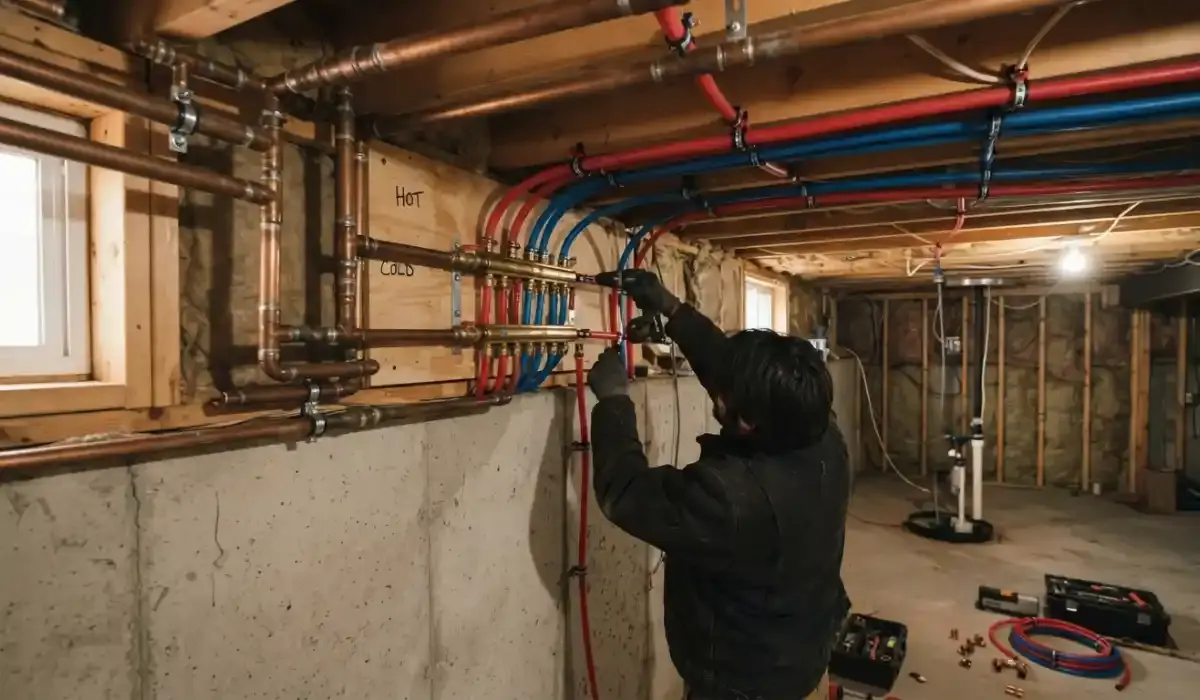
Repiping means replacing the supply pipes in a building, either whole or in part. It is a big job, and we do not recommend it when a repair will do. But in an older building where pipes keep failing, repiping is often cheaper and less disruptive than a string of emergency calls.
East Orange has plenty of older buildings. The city's draft housing plan says 29.8 percent of occupied homes were built in 1939 or earlier, and the median year built is 1957. Pipes from those years may be galvanized steel or older copper, and they may be near the end of their service life. Call (973) 488-5410 and we will look at what you have.
Signs Your Supply Pipes Are Failing
One leak does not mean you need repiping. Repeated leaks do. If you have fixed a pinhole leak and a new one has appeared a few feet away, the pipe is thinning from the inside and the next leak is likely already forming.
Other signs include low water pressure that has gotten worse over time, brown or rusty water when you first open a tap, and pipes that are visibly flaking or crusted at the joints. Low pressure in only one fixture is usually a clog in that fixture, but low pressure everywhere points to the pipes or the service line.
Age alone is not a reason to repipe. A building with sound, flowing pipes and no leak history can run a long time more. We would rather tell you to wait than sell you a job you do not need, and a pressure check or a look at a cut-out section of pipe usually shows which case you are in.
- Pinhole leaks that keep returning in different places.
- Low pressure at every fixture, getting worse over time.
- Brown, orange or discolored water at first draw.
- Visible corrosion, flaking or green crust on pipes and joints.
- Wet spots on walls and ceilings with no clear source.
Galvanized And Old Copper Pipe
Galvanized steel pipe was coated with zinc to resist rust, but the coating wears away and the pipe corrodes from the inside. Rust builds up on the inner wall and narrows the pipe, which is why pressure drops. Eventually the wall thins and leaks.
Copper lasts much longer, but it is not immune. Water chemistry, flow speed and age can cause pinholes. The city describes East Orange water as very hard, and mineral scale can form inside old pipes, narrowing them and reducing flow. A section of pipe cut out during a repair tells us a lot about what the rest looks like.
Copper Or PEX: A Fair Comparison
Both materials are approved for supply piping, and both can be installed well. The right choice depends on the building, the access and your priorities. We describe both and recommend one when the building points clearly in a direction.
| Factor | Copper | PEX |
|---|---|---|
| How it is made. | Rigid metal tube joined by soldering or fittings. | Flexible plastic tubing joined by crimp or expansion fittings. |
| Access needed | Needs straight runs and more openings for fittings. | Bends around corners, so it often needs fewer openings in walls. |
| Freezing | Can split when frozen. | Tubing can often expand a bit, but fittings still need protection. |
| Heat and sun | Handles heat well | Needs protection from sunlight and care near heat sources. |
| Long track record | Used in homes for generations. | Newer, and widely used in new construction and repiping. |
Repiping An Occupied Multifamily Building
Most East Orange buildings have several units, and the work happens with tenants living there. We plan it in phases. We usually work in one riser or stack at a time, which means water is off for part of a day in the affected units rather than for weeks.
We give tenants notice with the planned dates, so they know when water will be off and what to expect. We keep hot and cold available where we can, and we leave a clean worksite each day. A manager who is planning a building-wide project should call us early, because the order of work depends on how the risers are laid out. See our commercial plumbing page for how we handle multi-unit properties.
How A Repiping Job Runs
We start with a walk through the building to see the risers, the main and every fixture. Then we agree on a plan, including which units are affected, where walls will be opened and how long water will be off at each stage. In an occupied building, that plan goes to the manager and tenants before the first cut.
On the day, we shut off water to the section, remove the old pipe and run new pipe in its place, then pressure test every joint before anything is covered. Water is back on the same day wherever we can manage it.
Wall Access And Patching
Most repiping means opening walls and ceilings to reach the old pipes. We locate pipe runs first and cut access holes where they are needed, and we try to use existing chases and closets when possible. We place new pipe in the same paths where we can.
We patch drywall and plaster to a paint-ready surface, and we tell you before the job starts whether finish painting or tile repair is in our scope. If your building has plaster walls, tile or decorative finishes, tell us at the start so we plan access carefully.
Permits And Licensed Work
Replacing supply piping is not ordinary maintenance under N.J.A.C. 5:23-2.7. Plumbing work in New Jersey must be performed by a master plumber, an authorized plumbing contractor, under N.J.S.A. 45:14C-1, and the permit is signed by the licensee. The permit application lists the plumbing contractor's license number, and the work is inspected.
Confirm the details for your address with the East Orange Building Division at 973-266-5320, at City Hall, 44 City Hall Plaza. We handle the permit and the inspection scheduling for the work we do.
Hard Water, Scale And Your Pipes
The city's hard water page describes East Orange water as very hard. Hard water leaves mineral scale in pipes, fixtures and water heaters. New pipe will scale too, but over time and at a slower pace than a pipe that is already rough inside.
The city's softening page notes that softened water can raise lead and copper leaching from brass fixtures after standing overnight, so ask us about the tradeoff before adding a softener. See our water heater replacement page for how scale affects tank life.
What Repiping Costs: The Pricing Factors
Repiping Near East Orange
We repipe homes and buildings in Orange, Newark, Bloomfield, West Orange and Irvington. If you are not sure whether a repair or repiping is the right call, our leak detection service can show where the pipes are failing.
Code And Standards Reference
Replacing supply piping is not ordinary maintenance under N.J.A.C. 5:23-2.7, so repiping normally needs a permit and inspection under the plumbing subcode (N.J.A.C. 5:23-3.15). The State of New Jersey lists that subcode as the National Standard Plumbing Code, 2024 New Jersey edition.