
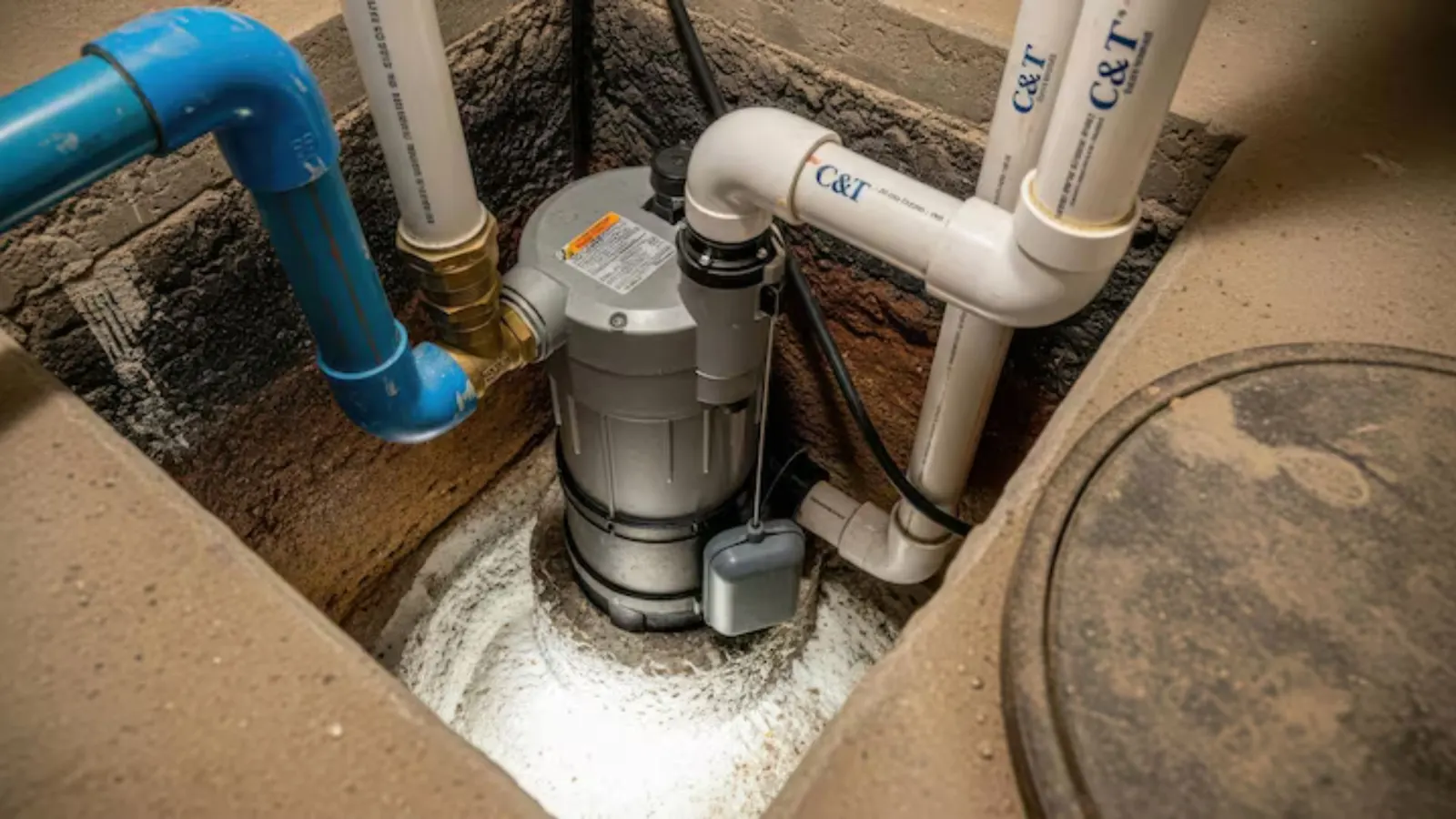
A sump pump sits quiet for months, then has to work perfectly on the worst night of the year. When a storm pushes groundwater toward a basement, the pump is the only thing between that water and your floor. If it fails, the first sign is often an inch of water on the basement slab.
We install, replace and repair sump pumps and sewage ejector pumps in East Orange at any hour. A pump that has stopped during a storm is a true emergency, and we respond that way. We also install the backup systems that keep the pump working when the power goes out.
Pump Failed During A Storm? Do This First
Water is coming in and the pump is silent or running without moving water. These steps limit the damage.
Check the power
Look for a tripped breaker, an unplugged cord or a GFCI outlet that needs a reset. Do this only if you can reach the outlet without standing in water.
Stay out of standing water
Standing water in a basement can reach outlets and appliances. If you cannot reach the panel dry, do not try.
Move belongings up
Lift boxes, rugs and electronics off the floor and onto shelves while you wait.
Call and tell us what you hear
A humming pump, a pump that runs without pumping and a silent pump point to different problems.
Why Storms Break Pumps In East Orange
The city's 2018 master plan says Superstorm Sandy brought basement flooding throughout East Orange and flooding along the Second River, also called the Watsessing River, and Nishuane Brook. It also notes power outages citywide. A pump with no power does nothing, which is why storms and outages cause most failures.
Hurricane Ida in 2021 set a rainfall record in nearby Newark, with more than 3 inches in one hour. A burst of rain that heavy can fill a pit faster than a small pump can empty it. It is a good argument for a pump with enough capacity and a battery backup.
Why Pumps Fail: The Usual Causes
Most failures come down to a few parts. A stuck float switch keeps the pump from starting or from stopping. A failed check valve lets water flow back into the pit and the pump cycles constantly. A clogged intake, a worn motor or a dead cord also stops the work.
Age matters too. A pump that has run for many seasons loses capacity, and a pump that never ran during a dry year can seize. We test the pump, the float and the check valve, and we replace what has failed rather than the whole system.
Battery Backup, Check Valves And Float Switches
A battery backup is a second pump powered by a battery that takes over when the power fails or the main pump cannot keep up. It matters most in a storm, when outages are likely. We explain how long it runs and what it needs to stay charged.
The check valve sits on the discharge pipe and stops water from flowing back into the pit after the pump stops. A float switch senses the water level and turns the pump on and off. These small parts do most of the work, and a failed one looks like a failed pump.
| Component | What it does | Sign it is failing |
|---|---|---|
| Float switch | Starts and stops the pump with water level. | Pump will not start, or runs without stopping. |
| Check valve | Keeps discharge water from returning. | Pump cycles often, water noise after it stops. |
| Battery backup | Runs a second pump without power. | Alarm, dead battery, no run during an outage. |
| Pump motor | Moves water out of the pit. | Hum without flow, overheating, grinding. |
Pit Sizing And Installation Time
A pit has to be large enough to hold water between pump cycles. A pit that is too small makes the pump cycle too often and wear out early. We check the pit, the inlet and the discharge route before picking a pump.
Installation time depends on whether a pit exists. Replacing a pump in an existing pit is a shorter job. Digging a new pit means breaking the slab, setting a basin, running the discharge and restoring the floor, which takes longer. We give a clear scope before we start.
Where The Discharge Goes: Confirm Before You Connect
We do not state discharge rules for New Jersey or for East Orange here. The rules are not confirmed in the sources we use, and the wrong connection can create problems for you and the system. Confirm the discharge rules with the Building Division at 973-266-5320 before connecting to anything.
That includes connecting a pump to a sanitary sewer line, a storm drain or the yard. We plan the discharge route with you and check the rule that applies to your address. If you are unsure, call the Building Division first.
Sewage Ejector Pumps For Basement Bathrooms
A basement bathroom sits below the building's sewer line, so waste cannot flow out by gravity. A sewage ejector pump collects the waste in a sealed basin and pumps it up to the sewer line. It is a different machine from a sump pump and handles solids.
The basin is sealed and vented, and the pump has its own check valve and float. A failure shows up as slow drains in the basement bathroom, odors and sometimes a backup. Replacing the ejector is a standard job, and a new installation means a permit and a licensed plumber, so we call the Building Division at 973-266-5320 to confirm the permit steps for your address.
Sump Pump Or Basement Waterproofing?
A sump pump handles water that is already under the slab or around the foundation. It does not stop water from coming in through walls or cracks. Our basement waterproofing page covers interior drainage and how a pit fits into a larger system.
If the real source is a leaking pipe, that is a different problem. A leak detection visit finds a plumbing leak that can look like groundwater. We check for that before we recommend a pump.
What Sump Pump Work Costs: The Pricing Factors
We explain the price before we start. These five factors decide it.
Sump Pump Service Near East Orange
We service pumps across Orange, Newark, Bloomfield, West Orange and Irvington. The same 24/7 number reaches us. If the basement is flooded by a failed supply line, see burst pipe repair.