
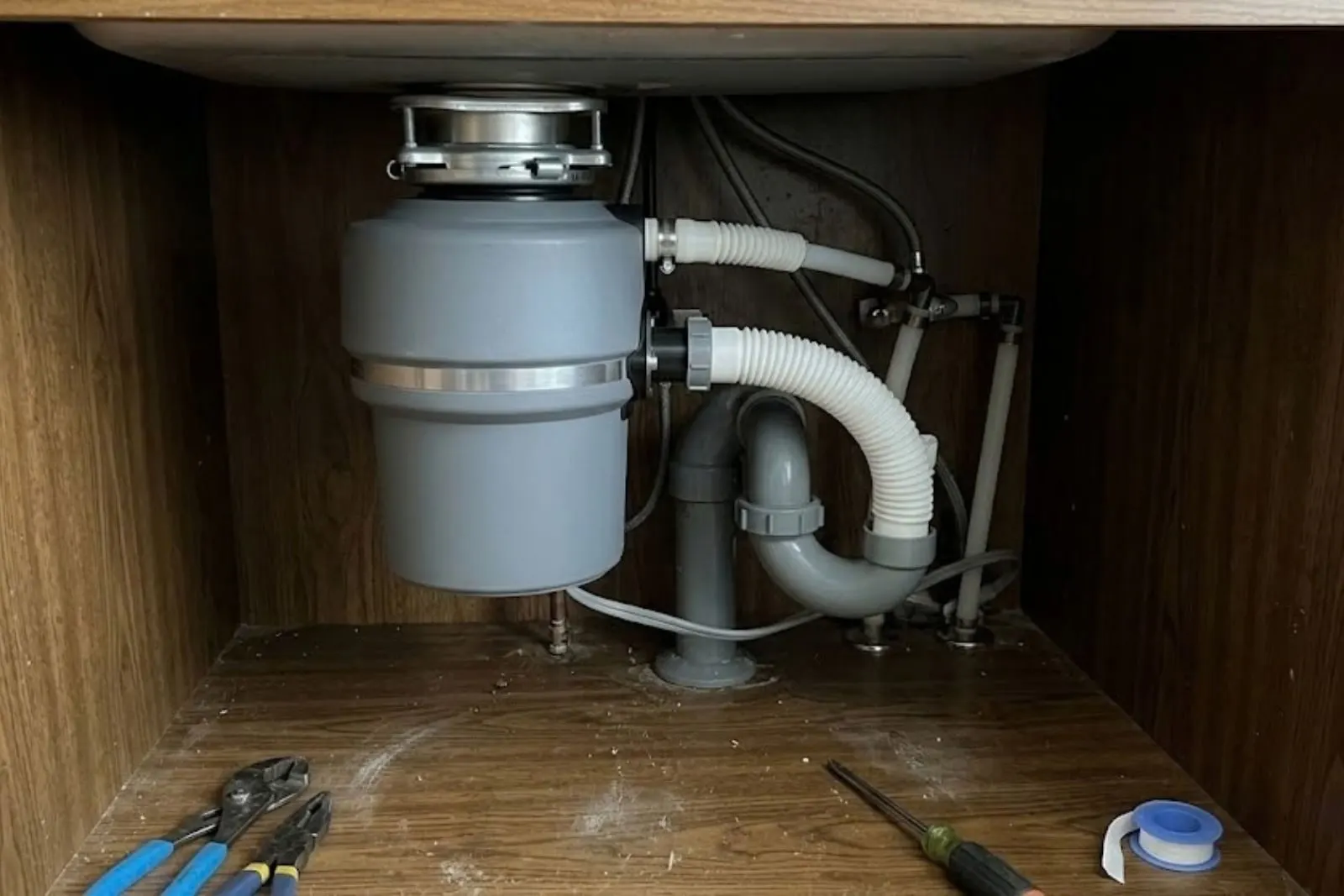
A garbage disposal sits at the center of a kitchen, and when it fails, the sink usually fails with it. It may hum without turning, leak from the bottom, or send water up into the other side of the sink. We repair and install disposals in East Orange at any hour.
Many of the apartment kitchens in the city have a disposal that the tenant did not choose and the landlord has not looked at in years. Whether the unit needs a quick reset, a new gasket or a full replacement, we tell you what we see before we start.
Disposal Jammed Or Dead? Do This First
A jam is the most common failure, and most of it is safe to handle if you follow the steps in order.
Power off first
Turn the wall switch off and unplug the unit or switch off its breaker. Never put a hand into a disposal, even when it is off.
Look with a flashlight
Shine a light down the drain and remove what you can see with tongs or pliers, such as a bottle cap or a bone.
Turn the shaft by hand
Many units have a hex socket on the bottom. A hex key turned back and forth frees the plates. Press the red reset button and try again.
Stop if water is leaking
Turn off the unit and place a bucket under it. Water from the bottom usually means the housing has failed and the unit needs replacing.
Humming, Grinding And Tripped Resets
A hum with no rotation means the motor is trying to turn but something holds the plates. Hard debris, a lodged utensil or a seized bearing can cause it. If the reset button trips again and again, the motor is overheating from a jam or has worn out.
Grinding noises usually mean metal or glass inside, not the motor itself. If a clean sink and a freed shaft do not solve it, a disposal that is more than a decade old is often better replaced than repaired. We compare the cost of each option on site.
Leaks At The Flange And Drain Connections
A leak can come from three places, and each has a different fix. The top mounting flange leaks when the plumber's putty or gasket has dried out. The side drain connection leaks at a loose or cracked gasket. The bottom of the housing leaks when the internal seal has failed, and that repair is replacement.
To find the source, dry the unit, put a paper towel on the cabinet floor, and run water while watching. We tighten or reseal the flange and replace the drain gasket and trap pieces as needed. Hard water scale around fittings can make old connections weep, which is why we clean the mating surfaces before reassembly.
Clogs That Back Up Into The Dishwasher Or The Other Sink Bowl
When the sink fills after the dishwasher runs, the dishwasher drain hose is often connected to the disposal, and the blockage sits between the disposal and the trap. Food that was ground but not carried away settles in the trap arm and builds up. A newly installed disposal sometimes backs up because the knockout plug for the dishwasher inlet was never removed.
A dishwasher drain loop or air gap is part of a correct drain connection, and we check it when we find a backup. If the line past the trap is the problem, it becomes a drain cleaning job. Repeated kitchen backups in a shared building can also point to the kitchen stack, which we trace with a camera if needed.
Replacing Or Installing A Disposal
A replacement is straightforward when the sink opening and drain layout match. We remove the old unit, clean the sink flange, set the new mounting assembly, connect the drain and dishwasher hose, wire or plug in the unit and test it with water. A new installation in a kitchen that never had one needs a power source and a switch, which may call for an electrician.
Horsepower, feed type and noise insulation matter for a household. Continuous feed units start with a wall switch, while batch feed units run when a stopper is in place. A disposal replacement is a fixture swap, and changing the piping arrangement is a different category, so we tell you if your layout needs a permit review through the Building Division at 973-266-5320.
What Should Not Go Down A Disposal
A disposal is a grinder, not a trash can. Grease and oil cool and coat the drain line, and fibrous items like celery, corn husks and onion skins wrap around the plates. Coffee grounds and eggshells settle in the trap and make a paste.
Rice, pasta and potato peels swell with water and form a dense plug. Bones, fruit pits and hard shells can jam or damage the plates. When in doubt, scrape it into the trash or a compost bin.
Typical Disposal Problems And Their Fixes
| Symptom | Likely cause | Typical fix |
|---|---|---|
| Hums and does not spin. | Jammed plates | Power off, free the shaft with a hex key, press reset. |
| Nothing at all | Tripped reset, breaker or dead motor. | Check reset and breaker, replace the unit if the motor is dead. |
| Water at the top of the unit. | Flange putty or gasket failure. | Reseal or replace the mounting assembly. |
| Water from the bottom. | Failed internal seal | Replace the disposal. |
| Sink backs up with dishwasher. | Blocked drain arm or a knockout plug never removed. | Clear the trap arm, open the plug, check the drain loop. |
Rental Apartment Kitchens
Renters make up 69 percent of occupied homes in East Orange, so a large share of disposal problems belong to someone who does not own the unit. Tenants should report a leaking or dead disposal to the landlord rather than swapping it out. Landlords should arrange repairs in writing, especially when a leak could reach the unit below.
In buildings where kitchens share a stack, a backup that appears in one sink may originate elsewhere. Managers who need a record can ask for a written note after the visit. Our commercial plumbing page explains how we handle multi-unit properties.
Keeping A Disposal Working Longer
Run cold water before, during and for about 15 seconds after grinding, so the waste is carried past the trap. Cold water keeps any fat solid enough to be chopped and flushed instead of smeared on the pipe walls. Feed scraps in small amounts rather than a full load at once.
A cleaned disposal smells better and wears less. Ice cubes and a small amount of dish soap help scour the walls, and citrus peel can freshen the chamber if it is cut small. Skip chemical drain cleaners, which damage seals and can burn skin when someone later opens the trap.
Have a disposal that shakes, runs hot or leaks slowly looked at early. Small problems become full replacements when ignored, and a leak under the sink can rot a cabinet floor before anyone notices.
What Disposal Repair Costs: The Pricing Factors
We give you the price before work starts. A reset and a full replacement differ widely, and these factors explain it.
Garbage Disposal Repair Near East Orange
We service kitchens throughout the area, including Orange, Newark, Bloomfield, West Orange and Irvington. If your sink is leaking or backing up now, call (973) 488-5410 and we will help you sort out what to do first.
Code And Standards Reference
Installing a disposal touches the drain, so it follows the plumbing subcode of the New Jersey Uniform Construction Code (N.J.A.C. 5:23-3.15). Like-for-like fixture and appliance replacement in a single family home is treated as ordinary maintenance when no piping changes, according to N.J.A.C. 5:23-2.7.