
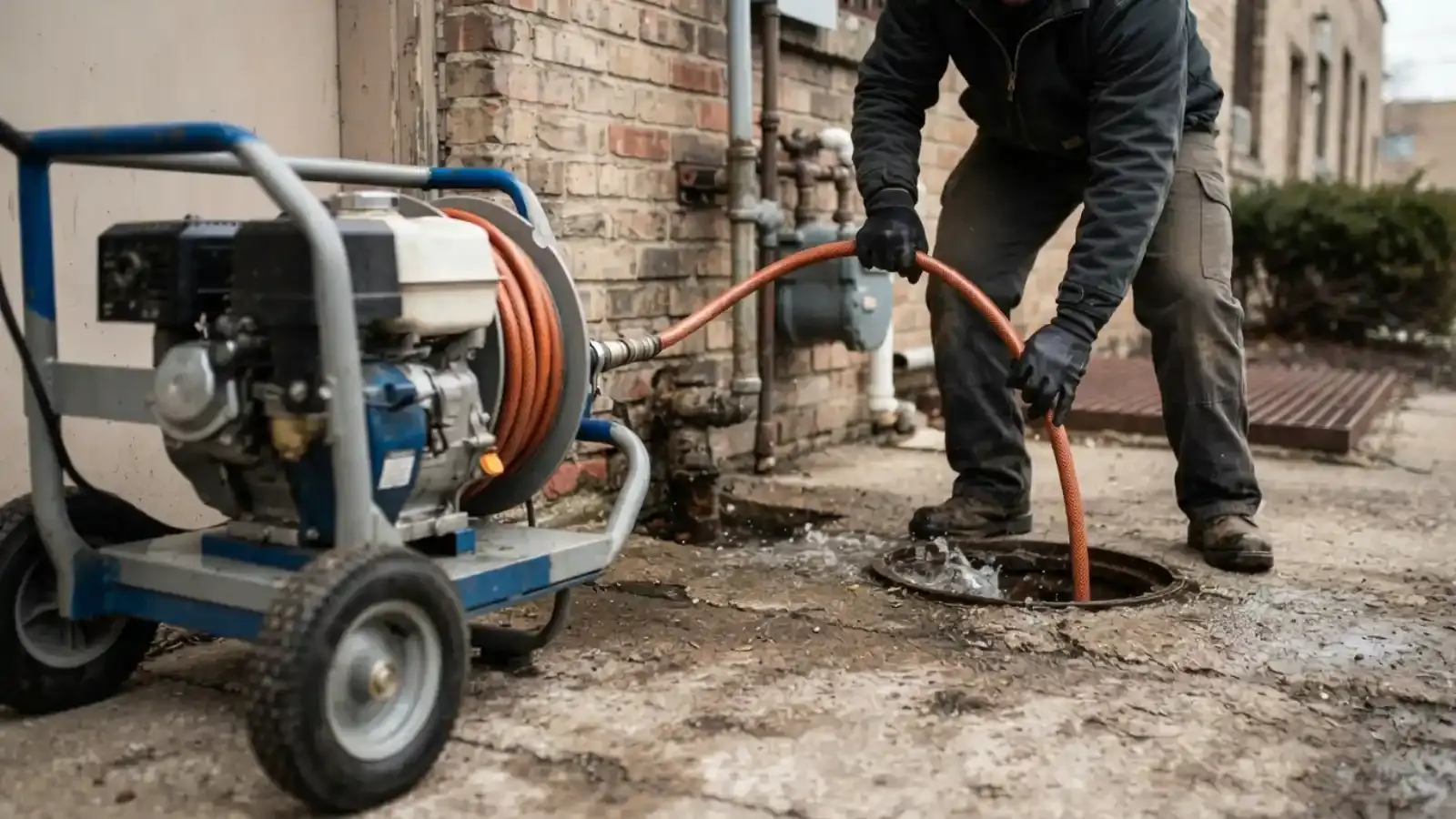
Hydro jetting uses a stream of water at high pressure to scrub the inside of a pipe. Where a cable cuts a hole through a blockage, a jet cleans the whole wall. In kitchen stacks and main lines coated with grease and scale, that difference decides whether a drain stays clear for weeks or months.
We jet drain and sewer lines in East Orange at any hour. A jet is not right for every pipe, and we do not use it on lines that cannot take it. The first step is always working out what the pipe is made of and what shape it is in.
How Hydro Jetting Works
A hose with a specially shaped nozzle is fed into the pipe through a clean-out. Water goes through the hose at high pressure and exits the nozzle through small jets, some pointing back toward the machine and some forward or to the side. The rear jets pull the nozzle forward through the line, and the forward and side jets break up buildup and flush it out.
The technician works the nozzle back and forth, feeding the hose slowly and pulling it back. The loosened material washes toward the main or the street connection, where it clears. The result is a pipe wall scrubbed back toward bare material, not a channel punched through the middle.
Nozzle Types In General Terms
Different nozzles do different work. A forward-facing nozzle is for opening a heavily blocked line. A wide-angle spray nozzle is for scouring the wall once the line is open. A nozzle with cutting edges or rotating action is used for roots and hard scale.
We choose the nozzle from what the line holds. Grease needs scouring. Scale and roots need cutting or rotating action. A technician may change nozzles during one job, starting with a small opening and finishing with a wall-scrubbing head.
What Jetting Is Good For
Jetting is best for buildup that a cable tends to leave behind. Grease, soap residue, scale and silt coat the pipe wall, and a cable can open a channel without removing them. A jet removes them.
It also handles roots in sound pipe. A cable cuts roots, but a jet with the right nozzle clears the fine ones that remain, and flushes them out. If roots keep returning, a camera inspection tells us whether the joints are open.
| Situation | Jet or cable? | Why |
|---|---|---|
| Grease in a kitchen stack. | Jetting | Scrubs the whole wall, not just a hole. |
| Hard water scale | Jetting | Cutting action can remove scale a cable skips. |
| Roots in sound pipe. | Jetting or cutting cable. | Depends on root mass and pipe condition. |
| Single toilet clog | Cable or auger | Jetting is more than the job needs. |
| Cracked, collapsed or offset pipe. | Neither until a camera check. | Pressure can worsen a damaged pipe. |
When Jetting Is Not Safe
High pressure water can make a bad pipe worse. A collapsed, cracked or offset pipe can be broken further by a jet, and water forced out through a crack can wash away the soil around the pipe. Some very old or thin-walled pipe is also a poor candidate.
That is why a camera comes first when we do not know the pipe. A look through a sewer camera inspection shows whether jetting is safe. If it is not, the right step is a sewer line repair, and we will tell you that instead of risking the pipe.
Hard Water Scale And Older Pipe
The city's own hard water page describes East Orange water as very hard. Over years, hard water leaves mineral scale on pipe walls, and the scale builds a rough surface that catches grease and hair. That is why a drain in an older building can slow down again soon after a simple cable pass.
Jetting removes much of that scale where the pipe is sound. This matters in a city whose housing data shows a median build year of 1957, since much of the pipe is old. The camera tells us how much scale is on the wall and whether the pipe can take the pressure. Heavily scaled cast iron sometimes needs a cutting nozzle first and a scouring nozzle after, and we plan the sequence from what the footage shows. We will say honestly if the wall is too thin or pitted to jet.
Restaurants And Multifamily Kitchen Stacks
Restaurant drains and apartment kitchen stacks collect the most grease. A stack serving many apartments receives cooking grease from each unit, and it sets up as the pipe cools. A cable pass opens a gap, but the wall stays coated, and the clog returns.
A jetting visit scrubs the stack and the line below it. For a restaurant or a larger building, we can set a maintenance interval so the line is cleaned before it blocks. About 38 percent of East Orange units are in buildings of 20 or more units, according to the city's draft housing element, so shared stacks are common here. See commercial plumbing for how we handle larger properties.
Pressure And Water Use, Explained
The cleaning power of a jet comes from pressure and flow together. Pressure gives the water force to break buildup loose, and flow carries the loosened material away. Jetting machines are rated for both, and the settings are chosen for the pipe size and material.
The technician does not run the machine at its highest setting every time. Lower settings suit smaller or older pipe, and higher settings suit larger, sound lines. A jet uses a good amount of water because the flow is what carries debris to the main. We keep the machine moving so the water is working on the pipe and not sitting in one spot.
Jetting Or Cabling: Choosing The First Pass
A cable and a jet solve different problems, and a good technician picks between them. A cable is quick and works well on a soft blockage in one spot, such as a wad of paper or a hair mass. A jet is slower to set up but cleans a longer stretch and leaves the wall in better shape.
We often start with a cable when a line is completely blocked, since a jet needs somewhere for the water to go. Once the line is open, jetting follows if the buildup is heavy and the pipe is sound. Our sewer line cleaning page explains the cable side of that pairing.
What Happens On A Jetting Visit
The technician finds the clean-out, checks the line and chooses a nozzle. If the pipe is unknown or the line has clogged repeatedly, a camera pass comes first. The hose goes in slowly, and the water works from the farthest point back toward the clean-out.
Water and loosened debris come out toward the main, and the technician watches for any sign of trouble, such as water surfacing in a place it should not. When the line runs clear, we flush it and test it under normal use. If the camera showed damage along the way, we stop and explain the repair options, since we will not keep pushing pressure into a broken pipe.
What To Do While You Wait
If a line is backing up now, these steps help until the crew arrives.
Stop using water
No flushing, showers or laundry until the line is clear. Tell the other units.
Keep the clean-out reachable
Clear boxes and stored items so the machine and hose can get to it.
Do not use chemical openers
They do not clear grease masses well and are a hazard for the technician who opens the line.
Note the pattern
Which fixtures back up and when. It helps us decide whether this is a branch, a stack or the main.
What Hydro Jetting Costs: The Pricing Factors
We explain the price before we start, and we do not name a figure on the phone for a line we have not seen.
Hydro Jetting Near East Orange
We jet lines in Orange, Newark, Bloomfield, West Orange and Irvington. For routine blockages, drain cleaning and sewer line cleaning describe the other tools we use.