
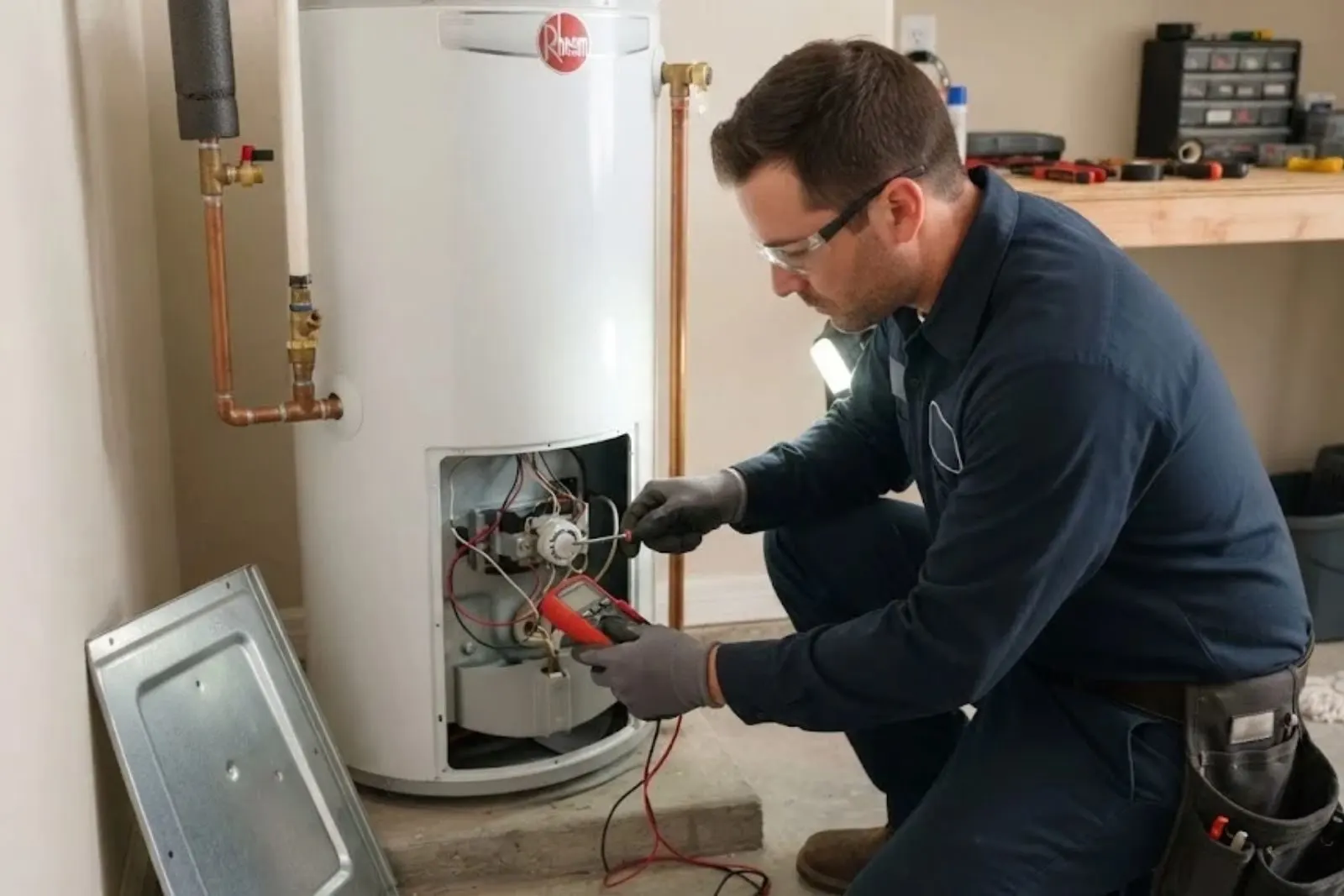
A thermocouple is the small copper probe that sits in the pilot flame of a gas water heater. When it goes bad, the pilot lights while you hold the control knob down and goes out the moment you let go, and the tank never heats. Replacing the part is one of the few gas water heater repairs a careful homeowner can do, and the work is usually short.
This guide shows how to confirm the thermocouple is the problem, what a replacement involves and where the safe limit sits. One rule outranks everything else. If you smell gas at any point, stop, leave the building and call PSE&G from a safe distance.
It applies to a standard gas storage heater with a standing pilot. Models with electronic ignition have no thermocouple, and tankless units are a different repair.
Signs The Thermocouple Is Failing
The thermocouple generates a tiny electrical signal while the pilot flame heats its tip. That signal holds the gas valve open. If the probe is worn, sooty or bent out of the flame, the signal drops, and the valve shuts the gas off as a safety step.
That is why the symptoms look the same every time. The heater is doing what it was built to do when it cannot prove a flame is present.
- The pilot lights while you hold the knob in, then goes out a few seconds after you release it.
- The pilot stays lit for a day or two, then dies again with no draft or other obvious cause.
- You have no hot water, and the burner never comes on when the water cools.
- The tip of the probe looks black, flaky or bent when you look at it with a flashlight.
Rule Out Other Causes Before Buying A Part
A thermocouple costs little, but a wrong guess still costs an evening without hot water. Look at the flame first. A steady blue pilot that wraps the tip of the probe points to a bad probe or a weak gas control. A tiny, wavering or yellow flame points to a dirty pilot tube or a draft problem.
The table below lists the common patterns. Treat it as a way to sort your symptoms, not as a diagnosis from a distance.
| What you see | Likely cause | Reasonable next step |
|---|---|---|
| Pilot lights, drops out after release, flame looks healthy. | Worn thermocouple or weak gas control. | Replace the thermocouple with a matching part. |
| Pilot flame is small, yellow or flickering. | Dirty pilot tube or orifice, or poor combustion air. | Stop and call a plumber, because the burner area needs cleaning and a combustion check. |
| Pilot will not light at all. | Gas supply closed, blocked pilot tube or failed control. | Check the gas valve position once, then call a plumber if it still will not light. |
| Soot on the tank bottom or burner area. | Combustion problem, possibly venting. | Do not relight. Call a plumber for a vent and combustion inspection. |
| Pilot goes out only when a fan or dryer runs. | Backdraft or negative pressure in the room. | Call a plumber, because the cause is airflow and not the part. |
What A Thermocouple Replacement Involves
Match the part to the heater. Take the make and model from the rating plate, and compare the new probe's length and end fitting to the old one. Universal probes exist, but a poor fit leaves the tip out of the flame and the problem returns.
Gather the tools before you start. You will need a flashlight, a small wrench or nut driver that fits the connection at the gas control, a rag and the manufacturer's lighting instructions printed on the heater label.
The Replacement Steps
Set the gas control to its off position and wait several minutes so the burner area cools. Close the gas shutoff on the supply line to the heater, and remove the burner access cover. Loosen the thermocouple nut at the gas control by hand or with a light wrench, then slide the probe out of its bracket at the pilot assembly.
Install the new probe in the same bracket so the tip sits in the pilot flame path. Thread the nut in by hand, then snug it about a quarter turn with the wrench. Overtightening can crush the fitting. Replace the cover, reopen the gas shutoff and relight the pilot exactly as the label describes.
After relighting, watch the pilot for a full cycle. Turn the control to a normal setting and listen for the main burner. If the pilot holds and the burner lights, the repair worked. If it fails again, stop guessing. A failing gas control or a combustion problem needs a technician, and our water heater repair crew can diagnose it on site.
Gas Safety Comes First
If you smell gas at any point, do not try to relight anything. Leave the building right away and move at least 350 feet away. Once you are at a safe distance, call PSE&G at 1-800-880-7734 or call 911. Do not use light switches, do not look for the leak and do not start a car near the building.
Never use a flame to look for a leak, and never keep working after you notice the smell. A faint rotten egg odor near the heater is a reason to leave, not a reason to investigate. Report it first and ask questions later.
Carbon monoxide is the second risk. A heater that burns badly because of soot, a yellow flame or a blocked vent can produce it. If a carbon monoxide alarm sounds, get everyone outside and call 911.
DIY Or Call A Plumber: Honest Limits
A thermocouple swap on a heater you own, in a house you live in, with a part matched to the model, is a reasonable DIY job for a handy person. It involves no cutting of pipe and no new gas line.
Most of the risk comes from relighting and from missing another fault.
Call a plumber if you rent, because the landlord is responsible for the heater. Call one if the heater is in a tight closet, shows rust or soot, or has a pilot that will not stay lit after a new probe. Also call if you would be disturbing the gas valve or any gas fitting, because those connections need proper testing..
You can reach a technician at (973) 488-5410. Our water heater replacement team can tell you honestly when the tank has simply reached the end of its life.
What This Means In East Orange
East Orange gets its gas safety instructions from the utility. PSE&G's published steps are to exit the building, move at least 350 feet away and call 1-800-880-7734 or 911. We repeat them because they apply to every address in the city, from a house on a quiet block to a unit in a large building.
The city's draft housing element, prepared in 2025, reports that 69 percent of occupied homes are renter occupied and that 38.1 percent of units sit in buildings with 20 or more units. In those buildings the water heater is often a shared or landlord owned system. Tenants should report a pilot problem to the landlord and not open the heater themselves.
The city's own softening page notes that scale builds up in water heaters, and the city describes the local water as very hard. Scale at the bottom of a tank does not cause a thermocouple to fail, but it does add to heating time and noise. For permit questions on any water heater work, call the East Orange Building Division at 973-266-5320 to confirm what applies to your job.
What To Do Once The Pilot Is Back On
Keep the area around the heater clear. Do not store paint, solvents or cleaning products next to a gas appliance, because their vapors can ignite. Write the model and serial number on a card and tape it nearby so the next repair is faster.
If the heater is old, treat a thermocouple failure as a signal. A tank that has served many years and now shows rust, leaks or loud popping may be worth replacing instead of repairing. If you call us for a service visit, we will tell you what we see. You can reach the crew at (973) 488-5410 any hour, and we also serve nearby towns such as Orange and Newark.