
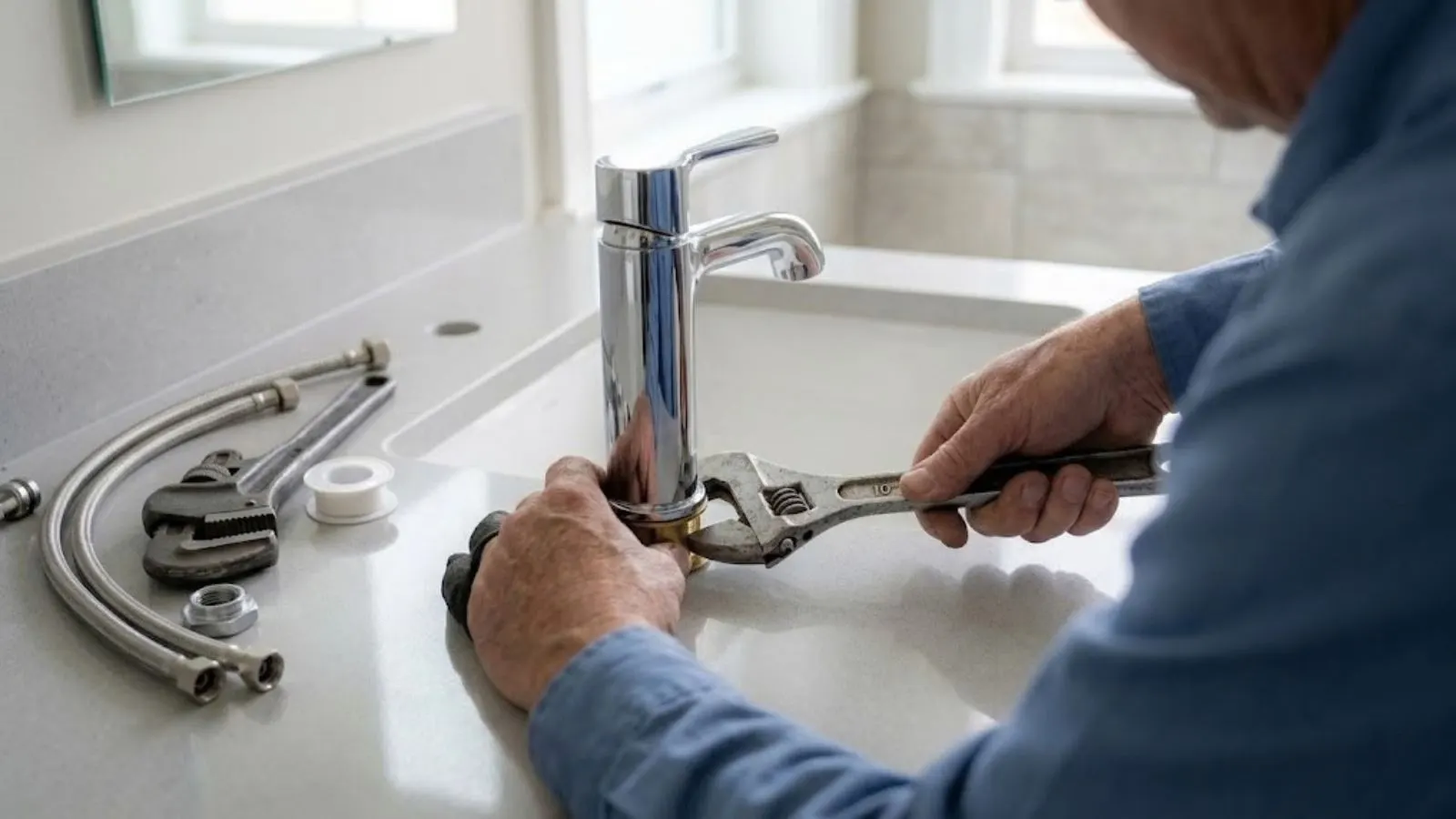
A kitchen sink looks simple, but it is two systems meeting under one counter. The supply side brings hot and cold water to the faucet. The drain side carries wastewater through a trap and into a vent-protected line that leads to the building drain.
This guide explains how each part works, which jobs are ordinary maintenance and which are plumbing work for a licensed professional. It also shows what a plumber looks at when a sink drains slowly, gurgles or leaks under the cabinet.
If water is leaking right now, close the two shutoff valves under the sink by turning them clockwise. If they will not turn, close the main shutoff for the building and call (973) 488-5410.
The Supply Side: Faucet, Lines And Shutoff Valves
Two small valves under the sink, called angle stops or shutoff valves, control hot and cold water to the faucet. Short flexible supply lines connect each valve to the faucet. When a faucet drips or a line leaks, you can close the valves and work without shutting off the whole building.
These valves are easy to ignore and tend to seize with age. Turn them once or twice a year so they work in an emergency, and replace one that drips at the stem. A valve that will not close is a reason to call a plumber rather than force it.
The Drain Side: Strainer, Tailpiece, Trap And Arm
Water leaves the sink through a basket strainer, drops through a straight tailpiece and enters the trap, the curved section that holds a small plug of water. That water seals the pipe so sewer gas cannot rise into the kitchen. From the trap, a horizontal arm runs into the wall.
Most leaks under a kitchen sink come from the slip nuts that join these pieces, or from the strainer seal at the sink. A bad seal and a loose nut look alike, so dry everything and watch where the first drop forms.
| Part | What it does | Typical trouble | DIY or plumber |
|---|---|---|---|
| Shutoff valves | Control water to the faucet. | Seized stems, slow drips. | Plumber if they will not close. |
| Supply lines | Connect valves to faucet. | Corroded fittings, kinks | DIY like-for-like in a home you own. |
| Basket strainer | Catches food, seals the sink. | Leak at the sink rim. | DIY with care |
| Trap and tailpiece | Holds water seal, carries drain. | Loose slip nuts, grease clogs. | DIY cleaning, plumber for changes to the layout. |
| Vent | Lets air in so the trap does not siphon. | Gurgling, slow drain across fixtures. | Plumber |
| Wall drain and stack. | Carries waste to the building line. | Repeated backups | Plumber |
The Vent Is The Part You Cannot See
Every drain needs air behind it. A vent pipe runs from the drain up through the wall to the roof so water can flow without pulling the trap dry. If the vent is blocked, you may hear gurgling or see the sink drain slowly even though the trap is clear.
Because the vent runs inside walls and above the ceiling, a vent problem is a plumber's diagnosis. If a plunger or a cleaned trap does not help, our drain cleaning crew can check whether the problem sits in the branch drain, the stack or the vent.
Dishwasher And Disposal Connections
A dishwasher drains through a hose that connects to the disposal inlet or to a tailpiece fitting under the sink. The hose is usually looped high under the counter so wastewater cannot flow back into the machine. A disposal bolts to the sink flange and discharges into the trap.
These connections are where grease and food waste collect. If the sink backs up when the dishwasher runs, the shared drain is likely partly blocked. Our garbage disposal repair team handles jams, leaks and replacement, and a clogged branch is a drain cleaning job.
Who May Do The Work In New Jersey
State law says plumbing work may only be performed by a master plumber or an authorized plumbing contractor. The construction code makes one exception. A single-family homeowner may do work on his or her own dwelling (N.J.A.C. 5:23-2.15). The exception does not cover tenants, landlords of multifamily buildings or a house you do not live in.
The ordinary maintenance rule (N.J.A.C. 5:23-2.7) also matters. Replacing a faucet, a trap or a valve with a similar one, with no change to the piping arrangement, is ordinary maintenance. Moving the sink, adding a fixture or replacing drain or supply piping is not, and that work needs a licensed plumber and usually a permit.
Whether an owner doing exempt work still needs an inspection is something we cannot confirm from the rule text. Ask the East Orange Building Division at 973-266-5320 before you start anything beyond a like-for-like swap.
Reading A Leak Under The Sink
Dry every joint with a paper towel, run water for a minute and touch each connection. The first spot that gets wet is the source. A leak that appears only when the sink is draining points to the drain side, and one that shows with the water running but the drain closed points to the supply side.
A weeping slip nut often needs a quarter turn by hand, or a new washer if the old one is flattened. A dripping strainer needs a new gasket or putty. A drip at the stem of a shutoff valve is a valve problem, and a valve that drips usually needs replacing. If the cabinet floor is soft or stained, call (973) 488-5410 because the water may have been running for a while.
What To Do Yourself, And What To Leave
- Safe for most owners: replacing a faucet with the same type, replacing a supply line, cleaning a trap and swapping a basket strainer.
- Better with a plumber: replacing a shutoff valve that will not close, changing drain piping, moving a sink or adding a fixture.
- Always a plumber: gurgling across several fixtures, backups that return, a leak inside the wall and any gas line near the sink area.
- Never do: mixing drain cleaner with a plunger, working near a gas line without turning off the supply or running power tools near standing water.
Small Habits That Protect The Sink
Scrape plates into the trash and keep grease out of the drain. Run cold water for a few seconds after using the disposal so ground food moves past the trap. Avoid storing cleaners in a tight pile under the sink, because a hidden leak can sit behind them for weeks.
Once a season, empty the cabinet, run water and look at every joint with a flashlight. Early drips are easy to fix and cheap to catch. If you find one you cannot explain, call (973) 488-5410 and describe where the water appears.
What This Means In East Orange
The city's draft housing element reports 38.1 percent of units in buildings with 20 or more units, and the Census Bureau's 2024 estimate, as shown by Census Reporter, puts multi-unit housing at 77.23 percent of the stock. In these buildings a kitchen drain often joins a shared stack that serves apartments above and below.
That is why one sink's backup can show up in another unit. A tenant who sees water rising under the sink should stop using water, tell the landlord and avoid pouring chemicals into the drain.
East Orange's water is very hard according to the city, and mineral scale forms on aerators and supply fittings. If your faucet needs attention, our faucet repair page covers it. We also serve Bloomfield and West Orange from the same phone line.